www.albertocontadornotebook.info - Alberto Contador Fans Notebook
contadorfans@hotmail.com
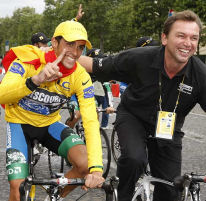

CYCLING AND FAME, LIFE AND DEATH
December 31, 2008
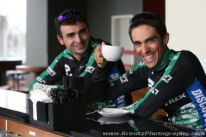
Alberto Contador and Samuel Sánchez talk it over
El Pais, November 10, 2008 - For cyclists, winter begins in the middle of October, at the Giro di Lombardia, the Race of the Falling Leaves. For cyclists on a winning season, these days of apparent inactivity are anything but restful.
This is a time for devouring almost as many miles of pavement as they do during the summer, with two differences: they cover the miles on four wheels, not two, and at the end of the journey there’s no winner’s jersey. Instead there’s a gala, a dinner, a tribute, a cicloturista ride, an article in the paper, an announcement, a reception, or an alubiada--the Basque equivalent of a chili feed.
Two weeks ago, Alberto Contador (Pinto, Madrid; 1982), winner of the Giro, Tour, and Vuelta, drove his Audi Q7 to Barajas airport and collected Samuel Sanchez (Oviedo, 1978), the Olympic champion. Together they headed to Bilbao where they participated in the VI Fiesta de la Bicicleta, organized by the Euskadi Foundation. Shortly before, they took time to chat with Unai Larrea of El País.
Samuel Sanchez.
The prizes are great, but they last most of the winter. Sometimes you wish that the season would begin so you could rest and train, because now it’s complicated even to find a date to go on vacation.
Alberto Contador.
I organize my schedule via my press man and my brother. Thanks to them, my ear is no longer growing to the phone. It’s a killer! In winter you only have a little time for yourself. You can’t enjoy your friends or family.
S.S. But we’re not complaining. This has been an extraordinary year for Spanish cycling. Giro, Tour, Vuelta, Olympics, Liége, País Vasco, San Sebastian, Paris-Nice…Nothing is impossible in this sport, but for a country to come back and win everything, that looks complicated to me.
A.C. A number of things have come together just right. If the Tour hadn’t banned the team (Astana), I wouldn’t have ridden either the Vuelta or the Giro. Spanish cycling is at a high point, and not just because more effort is being put into developing the younger generation. It’s simply that we have many quality riders in many areas.
S.S. We won the big classics.
A.C. Yes, but Spanish cycling is not at its peak in terms of sponsorship. In the Pro Tour, only one team is 100% Spanish, Euskaltel Euskadi. Caisse d’Epargne has a French sponsor and the sponsors of Scott-American Beef (old Saunier Duval) are American. Recently there were four teams. But I trust that, if things keep going like this, there'll be more Spanish sponsors.
S.S. Cycling has entered a new phase. They continue to encounter doping cases, like those of Riccó, Piepoli, Kohl, and Sella, but cyclists on the whole can be proud to belong to a clean sport. We go through more controls than any other athletes. We follow a special program, the biological passport. We pass controls at home and in competition. Plus, positives also occur in other sports, but when a cyclist is caught it causes a scandal. Cycling is healthy, the treatment we receive from the media isn’t fair.
A.C. There are things that I don’t understand. I don’t know to what extent it’s more profitable for a deep-pockets sponsor, or a city like Madrid, to devote five days to a sensational-looking tennis match or an entire year to a cycling team. I think it might be due to big business’ fear of positives. It happens in other countries. In Spain people have hope, but in Germany it’s been fatal.
S.S. And in Italy, things are not great.
A.C. Bettini told me that Riccò’s positive has done a lot of damage. He was the great hope of Italian cycling. He was my toughest rival in the Giro. He rode very strong. Too strong?
A cyclist can’t be suspicious of his rivals. I’ve never done that, because I don’t like it when others question me. When you lose, you can’t make excuses for yourself by saying “The others doped.” Also, every time, more people become aware and understand the new mentality, that the antidoping controls are increasingly effective.
People always say that, with doping, the thieves stay ahead of the law, but that hasn’t been borne out in reality. They’re coming up with new methods of detection, and that’s what happened in the Tour [positive tests by Riccò, Piepoli, and Kohl for CERA, a third generation EPO, undetectable prior to Tour 2008]. Things are going well.
S.S.Cycling is a thrilling show, and the Tour, the best race, is the one that makes it all worthwhile, that makes you vote to acquit. There’s so much press coverage that the whole world notices everything that happens. And it has history, tradition, legend.
A.C. I’ve always dreamt about the Tour. When I was an amateur, I was already thinking about winning it, but I didn’t say so because people would have said, “That kid’s got his head stuck in the clouds.” It changes your life. Things were one way before winning the Tour, but since winning it they're different. When I won Paris-Nice, here’s how my town found out: a report in a local magazine. But when I won the Tour and went home to Pinto, the reception gave me goosebumps.
S.S. And, as if you needed something else, now Armstrong is coming back. The announcement about his return left me perplexed. Why is the Patron of seven Tour victories coming back? Is he bored? He was retired for three years…Alberto, he’s creating a tricky situation for you. The road will put each of you in his place.
A.C. The situation won’t really be too tricky. The press has exaggerated the polemics.
S.S. The press will try to provoke fights between you and Armstrong.
A.C. I don’t want fights. At first I thought, with Armstrong on the team, that it was not a positive situation for me, but now I see it differently. I haven’t spoken with Armstrong yet, but I want to. Our relationship will be as comfortable as possible.
Shit, he’s the rider I’ve always admired most! When I was sick, he was my inspiration because of the way he confronted and defeated cancer.
S.S. My mother died of cancer. I lost her when I was 21. I lived with just her. My parents were separated. The loss of someone so dear changes your focus on things.
Life pins you to the wall with a sword, forces you to grow up. Morning, noon, and night, all I could think of was “I’ve lost her.” I was a professional cyclist, yes, but I didn’t know how to do anything else.
You have to cope without losing your head even though it’s not easy at 21 years old. You learn to value the things that really matter. Problems don’t exist on their own, we create them. This situation made me stronger.
A.C. My illness marked a turning point in my life. I’ve always been very ambitious when it comes to sport, but now I pay close attention to things I took for granted before, like having coffee with a friend.
When you spend that much time in the hospital, knowing if you’ll ever ride again becomes a secondary priority when you don’t even know if you’ll be able to live a normal life. You remind yourself that you could crash and become paralyzed or lose your eyesight any day. Then you really value what you’ve got.
When they told me that I could start cycling again, on November 27, it was 3 degrees and raining buckets, but I went out to train because it felt like a privilege, when before I might have been lazy because of the bad weather. When things are not easy, that’s when we give our best.
S.S. People think that we’re young, rich and famous, but I’m telling you, all that, without health, is worthless. Look at Ballesteros.*
The person who is truly rich is not the one who has more, but the one who has less and knows how to enjoy it. You have to enjoy the good times, to savor them, to express them. I’ll never forget what it felt like to win the gold medal in Beijing. The first person I hugged at the finish line was you.
A.C. It was a special hug, very emotional. The tears--and for me that’s something, I’m not touched easily. I felt like the victory was mine, too.
S.S. I really enjoyed watching you win the Giro. On the first day, when you only lost a few seconds, I saw it all, plain as day: “If he stays in the race, he’ll win the Giro.” And the month before you were relaxing on the beach. At least...that’s what you said.
A.C. It's true, I was on vacation in Cadiz! I had taken the bike even though nobody ordered me to, so I wouldn’t lose too many days of training. Luckily, a few days training are enough to put me in form.
S.S. Yeah, I used to be like that, too, but the years will catch up with you. You’ll see. (laughter)
*Spanish golf legend Severiano Ballesteros (www.seveballesteros.com ) collapsed at Barajas airport on October 5, and has subsequently undergone surgery to remove a brain tumor.
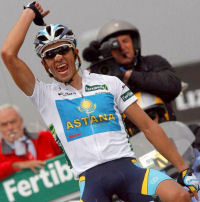
MEDIA
December 20, 2008
Retrospectives for 2008 are everywhere in the press, but this week both Paul Sherwen and Cadel Evans have been looking forward.
To them, Contador is the favorite in 2009.
PEZ CYCLING NEWS interviewed Sherwen from his home in Africa.
But how about that Alberto Contador with his Giro and Vuelta double?
“Outstanding – he’s the rider for the next five years,” was Sherwen’s view. “His class came out to me when he was thrown into the deep end at the Giro. He rose to the occasion, improved throughout the event, and then he won on sheer class. He was even more dominant at the Vuelta.
“I was happy for Carlos Sastre for him to win the Tour; he’s been consistent for many years and always an outside chance to win. But given his results from his last three Grand Tours, Contador is a very special rider indeed.”
PEZ wondered, given Contador’s relatively young age compared to other great champions, whether he is going to be dominant for many years.
“His climbing is second to none,” Sherwen added. “What is impressive is how his time-trialling ability has improved at the top level of the sport. The final time trial in 2007 put him on the ropes, but he went away, worked with Bruyneel and the team structure, worked on his position in the wind tunnel, so that he could finish in the top five in any time-trial event.”
So, the favourite for next year’s Tour?
“To me he’s the number one favourite,” Sherwen agreed. “But you’re all going to speculate, of course, whether in 8-months his major challenger is going to be his teammate.”
A cagey Cadel Evans is looking forward to another try at the Tour title. He spoke his mind to the Geelong Advertiser.
"I watch all my opposition closely, in the season and also out of it," Evans said yesterday.
"In some ways, it's in my favour having Contador back, it helps me control the race a bit, which was a problem for us a little bit in the tour this year. Lance's return is of interest to everyone of course, if he returns to something like his level before he quit. It will be in my interest to see how he goes in the Tour Down Under."
Next year's penultimate stage is up the steep slopes of Mount Ventoux in the Alps, described by Armstrong as the most difficult climb in France.
That finish will work in Contador's favour, with Evans admitting he would need a good buffer, hopefully gained in the time trial two days before to defend entering that stage. There is just the one lengthy individual time trial in which to make his mark with organisers opting for a team time trial.
"On paper, it's not in my favour, a team trial," he said. "Teams like Columbia and Astana and CSC are going to be tough, we're not usually as good when it comes down to depths of talent and money. Ventoux is in Contador's favour."
(Photo: EFE)
VUELTA 2009: CONTADOR KNOWS THE WAY
December 17, 2008
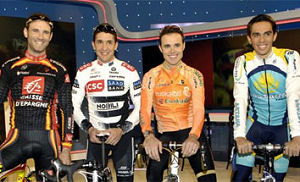 Today Alberto Contador attended the route presentation for the Vuelta a España 2009.
Next year's edition of the race is noteworthy for its departure in Holland and lack of mountain stages in the Pyrenees or Asturias.
Contador was the star of the event, along with his illustrious colleagues Alejandro Valverde, Carlos Sastre, and Samuel Sánchez. The trio commented on the details of the route and made their forecasts, although only Euskaltel’s leader Sánchez confirmed that he will ride the Vuelta in 2009.
Alberto left open the possibility of defending his 2008 title. “It’s an option, because this year the Vuelta left me with a great feeling. My goal in 2009 is the Tour de France, which I couldn’t race this year, but I’m leaving the door open to taking part in the Vuelta.”
As for next year’s parcours, Contador approved of the first week in the Netherlands, liking that it was “simpler, because Classics’ territory is not my specialty, even though I admit that the Vuelta needs a greater sense of anticipation in the first week, something more dangerous, keeping in mind that cycling is the king of sports in Belgium and the Netherlands.”
About the mountain stages, Contador said that there are “summits that can produce many time differences, and that’s what I like best about this Vuelta,” commenting in reference to the finishes at Aitana, El Catí, Velefique, Sierra Nevada, and La Pandera.
Contador said a few words about 2008, a magnificent year for Spanish cycling crowned by triumphs in the three grand tours and the Olympics. He noted the difficulty of repeating such a pattern of success. “To begin with, there are no Games in 2009, but as for the three grand tours, we will return to try to win them all.”
No Pyrenees or Angliru in 2009
Missing in the 2009 route—designed by Unipublic—are the two classic climbs of Asturias, the Angliru and Lagos de Covadonga. Nevertheless, the race will be a good one for climbers, with a greater number of taxing climbs than in 2008.
The race begins in the Netherlands with a circuit prologue in Assen, followed by three more stages, the final one tracing the path of the classic Liége-Bastogne-Liége.
After rest day with transfer to Spain by air, the Vuelta continues along the nation’s east coast. First comes a time trial in Valencia, followed by the first foray into the mountains, which will feature two tough finishes at Aitana and Xorret del Catí.
The race enters Andalusía after the second rest day, where riders will confront the mountains again, tackling consecutive summit finishes at Velefique, Sierra Nevada, and La Pandera. It stands to reason that the Vuelta will be decided here.
The usual late stages in the Sierra de Madrid will be followed by a time trial in Toledo. (AC press room)
See details of VUELTA 2009
Photo: A constellation of Spanish stars at the Vuelta presentation (MARCA)
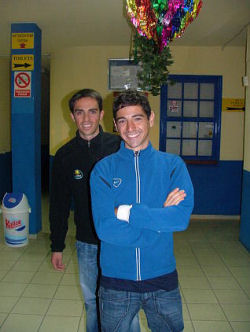
A NEW ESCUDERO FOR CONTADOR
December 13, 2008
Contador rings in the new season with an old friend at his side
Jesús Hernández has been Alberto’s Contador’s friend through thick and thin. Now they’re together at Astana.
Carlos García of La Opinión de Tenerife interviewed Jesús while the team were at training camp last week.
His name gets overlooked, and he’s not hounded by the paparazzi. Nevertheless, he’s one of those elements that’s essential to any roster.
After a year without a team, this Madrileño has burst onto the elite cycling scene to work as a self-sacrificing gregario.
Just as Laguía was to Perico, as Arrieta was to Induráin, and more recently as Inigo Cuesta was to Carlos Sastre, Jesús Hernández wants to become Alberto Contador’s right-hand man. The champion of the Tour, the Giro, and the Vuelta called him by name to be by his side.
How did your relationship with Alberto Contador begin?
"We’ve known each other since we were 14, when we lived within five kilometers of each other. Since then we’ve been on the same team, first as cadets, then as amateurs in Basque Country, then as professionals at Relax! Through it all we formed a friendship."
And now together again at Astana? A dream?
"We’re here thanks to him. Because he made a case for me with Johan, since he was the one that knew me best. Imagine! This is like Real Madrid in football, pretty impressive for rolling with both Contador and Armstrong, so I’m not complaining!"
Are you resigned to being considered just another gregario?
"That’s no problem for me—it’s just the opposite, because it’s flattering to be with a great monster like him. I’m proud that somebody as good as Contador trusts me as an athlete. That’s what makes you train more and better every day."
After a year on the bench, what crossed your mind when Contador proposed that you sign with Astana?
"Honestly, he didn’t say anything to me until it was all said and done, and I didn’t need any time to think it over. It was a pleasant surprise and I could hardly sleep that night!"
Did you get shaky in the legs?
"It wasn’t my legs that shook, but the ballpoint pen—when I signed the contract!"
What’s Alberto like on a daily basis?
"We have a very close relationship, both on and off the bike. First of all, he’s a person who is very, very, very well-equipped mentally. He knows what he wants and how to get it. He’s one of the few people I’ve ever known who gets whatever he set out to get. He does with ease things that seem almost impossible to you.
The cavernoma that he suffered in 2004, was that a turning point for him?
"At that time the things he valued most were outside of cycling, since he came close to being unable to ride again. But the personality of a fighter and constant desire for the very best have always been his."
Since you know him so well, is he wary of Armstrong’s return?
"No, no, no, you’ve got it backwards. I think that the return of Armstrong means a positive contribution to the group. He wants to win the Tour, and if Lance is a help, he’s welcome."
Are you impressed by being around a great rider like the American?
"It’s too early to feel confident. Imagine, when I was a cadet he won his first Tour. You watch his every move with admiration to see what he’ll do, because he’s been a very great person in the sport."
You’ve already been able to ride with him, what’s it like?
"Buffff!, really hard. He looks very, very lean , has very defined legs. Although as of today nobody knows how he’ll respond to a three-week race. Time will tell."
The virtues, faults, and fancies of a champion. Contador’s relationship with his training buddy Hernández is very special. And so, besides extolling his virtues, the new Astana rider also reveals some of Alberto’s foibles.
“He’s super messy, it’s incredible. The room is driving me crazy,” Hernández lets on between laughs, but also mentions, “hunting, dogs, and birds,” as some of Contador’s favorites.
And yes, “his greatest passion is bicycles,” explains the 27-year-old domestique, shining a light on something that’s easy to verify: that Contador enjoys his work.
Photo: Alberto and Jesús at Tenerife (La Opinión de Tenerife)
CONTADOR TO KAZAKHSTAN'S CAPITAL
December 11, 2008
Alberto Contador travels to the capital of Kazakhstan today, at the invitation of President Nursultan Nazarbayev. The president will host leaders of the Astana Cycling Team in an official visit to the city of Astana lasting until Sunday.
Joining the winner of the Tour, Giro, and Vuelta will be Johan Bruyneel, Levi Leipheimer, Andreas Klöden and Assan Bazayev. Astana Team’s Bazayev will act as host and guide.
Despite the severe Asian winter and its temperatures -20°, Contador is looking forward to the opportunity to offer his 2008 victories to the team’s sponsors and the people of Kazakhstan on their own soil, and to thank them for their support. (AC press room)
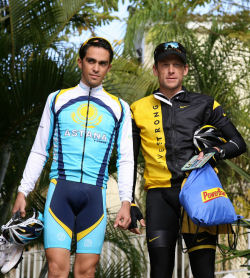
ALMOST LIKE BROTHERS
December 9, 2008
Like lifelong friends.
The long-awaited day arrived and, although they were rarely together at the same table, neither Armstrong nor Contador ever got off script.
They avoided with deft subtlety any controversial subject that might arise from the coexistence of two such men of stature at Astana in 2009.
In spite of stressing his intention to work for the strongest rider, the American couldn’t mask his eagerness to win.
Two phrases, “I’ve gone three-and-a-half years without competing, but it seems like it’s only been one winter,” and “I’m pleased to be cycling—in the afternoons I get bored in the hotel,” testify to Armstrong’s ambition in returning to the peloton.
Contador, on the other hand, admitted that he looked forward to Armstrong’s presence at the 2009 Tour, because “It’s the best showcase for him,” although he considered that “It’s still too soon to say whether he can win or not.”
“Armstrong has done things nobody else has ever done,” Contador added.
Objective: The Tour
Contador insisted that “Bruyneel has always known to enter the cockpit with several cocks” simultaneously; and he stressed that “the race will decide the leader.”
Contador said pointedly once again that his “main goal for 2009 is to try to win the Tour, so I’ve requested it of the team,” and that’s why his entire program “will be focused on it.”
“I’m going to sacrifice to achieve it,” he added.
Contador’s good manners continued, as he indicated, ”He’s a great icon,” and, “Riding together will be good for the team.”
On the other hand, the Texan admitted that Contador “is right now the toughest rider in the world,” and clarified that he “hasn’t come to take away anybody’s place” and if as time goes by he sees that things are not going as well as he’d hoped, he’ll tell Bruyneel “that I’m going home, and he’ll understand.”
Earlier Lance Armstrong repeated his compliments to the island, recalling that “Every time I’ve been here, I’ve won the Tour. The island, the Teide! The public is fantastic. Tenerife is one of the best places to train in the world. It’s an honor to be here.” (Carlos García for La Opinión de Tenerife)
Photo, top: Contador and Armstrong at Tenerife, December 2008 (Jaime Reina/AFP/Getty Images)
A TEAM WITH TWO HEADS
December 6, 2008
EL MUNDO reports today that Contador and Armstrong won’t ride together in 2009, except at the Tour de France.
According to the article, the roster has been broken up into separate teams for the two leaders.
Riding with Contador will be his teammates from Spain and Portugal: Chechu Rubiera, Dani Navarro, Sergio Paulinho, Jesús Hernandez and Haimar Zubeldia.
Projected race calendar for Contador’s squad is Mallorca, Murcia, Castilla y León, País Vasco, Dauphiné Libéré, Tour.
Riding with Armstrong will be Levi Leipheimer, Jani Brajkovic, Andreas Klöden and Yaroslav Popovych. (American Chris Horner stated in other sources earlier this week that he will also be on the Armstrong squad.)
Races for Armstrong and company are: Tour Down Under, Tour of California, Criterium International, Giro d’Italia, Tour, with options on Tour of Flanders and Circuit de la Sarthe.
The article doesn't mention assignments for other key riders, like Benjamin Noval and Tomas Vaitkus, nor for any of the riders from Kazakhstan.
An intriguing question not addressed in this article is how Astana will select a cohesive Tour roster made up of riders who have served essentially on two different teams in the months leading up to July.
The Spanish paper goes on to say that Contador will do intensive specific training in the mountains eight weeks before the Tour. It also reports that he’s interested in riding the World Championships again this year—a good route for climbers—and is considering the Vuelta a España.
ASTANA CHIEFS POWWOW WITH PRESS
December 4, 2008
"This guy on my left is the best cyclist in the world. It's pretty simple."
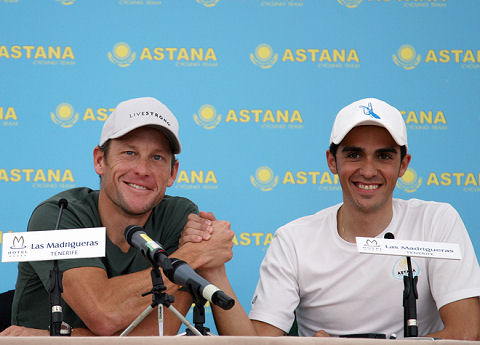
Contador and Armstrong mano a mano? (Jaime Reine/AFP/Getty Images)
Astana held a press conference today at the Hotel Madrigueras in Tenerife, headquarters of their team training camp. Manager Johan Bruyneel sat with leaders Alberto Contador, Levi Leipheimer, Andreas Klöden and the newest member, Lance Armstrong, to answer questions about Armstrong’s integration into the team and Astana’s plans for 2009.
About an hour of the cordial event (1:46 in duration) was given over to Armstrong, who discussed his feelings on re-entering competition and his LiveStrong cancer intitiative. Contador was interviewed afterward. Two or three questions were directed to Leipheimer and Klöden as the meeting drew to a close.
The burning questions have been, since his return, whether Armstrong intends to become Contador's rival under the same flag next July, whether Contador will be displaced by the American as leader, and whether a rider of Armstrong's star caliber would be willing to ride as a domestique to another rider.
Armstrong took steps to soothe worries about competing against his younger teammate and whether he would work for the team. However, interestingly, in bios given to the press, Astana states that, "In 2009, Armstrong will look to secure...an eighth Tour de France victory." According to Astana's bio for Contador, "Contador's 2009 season is focused on preparing for his second Tour de France title." The questions linger.
Armstrong, in answer to those who would see him as an interloper on a team already stacked with leaders, repeatedly stressed his conviction that he must be realistic and fair in taking a seat on the roster.
Armstrong's comments concerning Contador:
He fielded the question, "How do you feel riding in the same team with Alberto Contador?" as follows:
“Well, this is not my first experience with Alberto. As Johan can definitely tell you, we tried for many years while he was with Liberty Seguros and other teams, we tried for a long time to get him on the team. He’s been a rider that we’ve always admired and respected and thought had a bright future.
“But the team that I was a part of, the team I was part owner of, is the team that he won his first Tour with. It’s an organization that he knows, and he’s a rider that I know well. For me, it’s a big honor. I think that in 2008, and going into 2009, he’s the strongest cyclist in the world. Nobody can debate that.”
And:
“It’s not a new relationship…We started to race together in 2005. He came to Discovery some time after that. There’s been an existing relationship, there’s been existing mutual respect.
“I come into this atmosphere, as I’ve said a dozen times earlier, completely open to whatever happens, and loyal to Alberto, loyal to the team, loyal to the laws of cycling. So I’m not coming to take anybody’s job or to take anybody’s titles. I come for a different set of reasons.
“But at the same time I have a lot of respect for this man, I can’t say it any stronger. December 4, 2008, going into 2009, this guy on my left is the best cyclist in the world. It’s pretty simple.
“I could’ve won 70 Tours, and Eddy Merckx could come back, too. It doesn’t give you the right to lead the team. You have to prove that on the road.”
And one more: "Apart from experience, what is it you have that Alberto does not have?"
"Well, I'm older, so I've been around longer, I'm I think 12 years older. I've been racing professionally--with a couple of breaks, but more or less professionally--since 1992.
"How old was Alberto in 1992? Ten. (Contador laughs.) Which is scary. (Contador says his birth year in English--'82) Yeah, so he was ten when I turned professional.
"So with that comes race experience. But you know, I think Alberto obviously has a tremendous amount of natural talent, and he has a tremendous ability to read a race. And if he doesn't, if he has questions, in my opinion he's got the best coach and the best director in the business in the car, constantly within radio communication.
"So I think it will be very rare for him to make any tactical or strategic mistakes with Johan in the car."
PREMIO WITH WHIPPED CREAM AND A CHERRY ON TOP
December 4, 2008
Last night in Madrid, sports journal as.com distributed its awards for Spain’s best sportsmen of the year, as judged by readers who voted online.
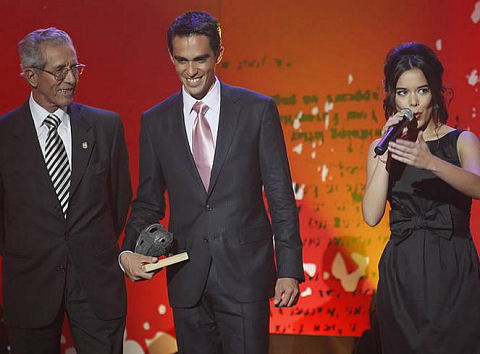
Contador serenaded at the Premios AS del Deportes awards (photo, as.com)
In a year marked by the great deeds of Rafa Nadal, the Spanish football team, Tour winner Sastre and Olympic medalists, the competition was stiff. But when Alberto Contador—winner of the Vuelta a Castilla y León, the Vuelta al País Vasco, the Giro d’Italia, the Vuelta a España, and cycling’s Triple Crown—crossed the stage to receive a trophy, no one was surprised.
as.com reports that Contador arrived fresh from Astana training camp in Tenerife to receive one of the three prizes for best sportsman of 2008, sharing the honor with Nadal and Spain’s Eurocopa team represented by captain Iker Casillas.
The magazine describes the scene as “a perfect night,” and says, “The Premio AS del Deporte is the icing on the cake of a spectacular season, served to him by Federico Bahamontes and garnished with a rendition of HAPPY BIRTHDAY sung by Beatriz Luengo, a la MARILYN MONROE."
Contador's birthday is Saturday, December 6. He will be 26.
In his acceptance remarks, Contador was proud to take his place among his colleagues on stage, and showed characteristic appreciation for the fans.
“I’m proud to have been chosen by readers. We’re living in a golden age of Spanish sport, and it’s enormously satisfying to have contributed to such a list of successes by offering my victories in the Giro and the Vuelta.”
“It gives me great joy to play a part in getting people interested in the spectacle of road racing again. There’s Sastre, with his Tour; Alejandro Valverde, with his stages in the grand tours and his classics; Samuel, with his Olympic gold in Beijing; Oscar Freire with his many triumphs…Spanish cycling took all the prizes this season. The only one missing was the Worlds.”
“My only objective for next year is to win the Tour de France again, the race that introduced me to the world and made my reputation. I am a winner, so I hope to return from Paris with my second triumph.”
Contador is back at Tenerife today for more training, and a press conference with Armstrong, Bruyneel and others at 3:30 (CEST).
VIDEO HIGHLIGHTS
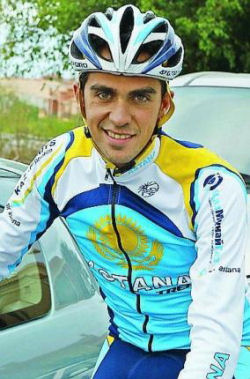
PEDALING AT TENERIFE
December 2, 2008
Alberto Contador rode his bike today for the first time since having surgery to correct a deviated septum. Satisfied with results on this second day of training camp, he said, “We did two and a half hours on hilly roads and I felt really good.”
In today’s outing Contador and a few teammates covered a climb of 1,300 meters.
“I’m highly motivated and very eager to start the season, just like the rest of the team,” he said. He commented that he’s nearly forgotten about his operation, except for a few post-op nuisances. That leaves him fit to pursue his plan of approaching form consistently without hurrying.
He’ll also be looking for an alternative to the recently-cancelled Vuelta a Valencia, the early block of racing that was to carry him to Paris-Nice.
Alberto and some of his teammates fed their appetites for cars and speed with an afternoon track-driving session. “The best thing about this camp is the chance to get to know one another better, to build friendships and get ready to work as a unit at competition time.”
He will address the topic of the Tour de France at a press conference on Thursday. (Contador press room)
Photo: Contador still recovering from surgery at Tenerife (EFE)
2009 SEASON DAWNS AT TENERIFE
November 30, 2008
Alberto Contador's new season begins with Astana team training camp at Tenerife on Sunday, November 30. The camp will last until December 8.
Contador is recovering satisfactorily from an operation last Monday to correct a deviated septum. Because of the recent surgery, he will not be able to take part in the full range of activities at training camp, focusing on work in the gym, with an option to begin training on the bike next Thursday.
How has this winter been?
Very busy. It was also busy during the winter of 2007 because of the aftermath of winning the Tour. This year’s been busy, too, because of the Giro and Vuelta. I’ve had a lot of commitments and haven’t been able to get away as much as I’d like, but mentally I’m good to go and want to get started. As soon as I get over the operation, I’ll start riding again and concentrating on training.
Are you eager to start racing again?
Yes, I’m a rider that likes to compete and to ride my bike. I want to get to the training camp, get to know my new teammates, say hi to the old ones, and start planning the season.
What do you expect from this first training camp?
Mainly it will be good to grow the feeling of solidarity in the team, because we’re not under any pressure right now and we can do things that will be impossible later. We’ll bond together as a strong group and work to get the year off to a good start.
What about Astana in 2009?
The team was very good this year, and great reinforcements have come. Everybody already knows how good Haimar Zubeldia is, there’s nothing more to say. He’ll play a central role in the three week races.
Another really good last-minute move has been getting Popovych back. He worked really hard in the 2007 Tour and I was very happy to learn that he's coming back. Then there are riders like my old training partner Jesús Hernández. The team's going to see him make a big leap forward in quality this year.
Lance Armstrong is coming, too. What will his contribution to the team be?
Without a doubt, his great experience. He’s managed to win seven Tours, which speaks volumes about his mental and physical abilities. His contribution will be very positive for the team, and competitively he’ll be rock solid. Even though nobody can say yet exactly how he’ll perform, I’m convinced that he’ll make us much stronger.
What goal are you targeting this year?
Definitely the Tour de France. It’s the biggest race in the world, the one that changed my life, and since I couldn’t be there this year, my biggest hope is to ride it again.
I’m well aware that it’s very difficult to win, thanks to the extremely high level of the riders that compete, and the millions of things that can happen in 21 days of racing. But I’ll fight with everything I’ve got to do it. Thinking about the Tour, as well as having had the operation, will make for a more relaxed start.
Besides the Tour, have you set yourself any other goal this season?
Yes, I also want to do specific work in the two different positions on the bike, the normal one and the time trial position, so that I can get the best return on my effort. Even though this year the amount of racing against the clock in the Tour is only about half that of 2007, one of my highest goals is to improve my time trial performance. And, of course, I want to keep enjoying the bike as I always have done.
What is it that motivates you most at a time like this?
Reaching my goals. I’m a rider who doesn’t shirk training, and so, yes, when my mind’s set on a goal, I like to reach it. I don’t just train to train. I like to make a flat out effort to get the maximum yield in competition. Afterward, I also like to rest, both physically and psychologically, because competition is even more exhausting mentally. (Contador press room)
SECOND CONSECUTIVE VELO D'OR PRIZE FOR CONTADOR
November 26, 2008
Alberto Contador has won the coveted Velo d'Or prize for the second year running!
He was chosen over a list of stellar candidates to receive the honor, finishing in the tally with 72 points, ahead of distant-second Fabian Cancellara, 47 points.
Alberto said, “I think this is one of the biggest prizes in the world because journalists from all over the world who are experts in cycling have voted."
The Velo d'Or, or Golden Bicycle, has been awarded annually since its inception in 1992 to the best cyclist of the year, as determined by a panel of international cycling journalists. It is sponsored by the French magazine Velo.
Velo shows no partiality to French riders when awarding the Velo d’Or, honoring the votes cast by the international panel. In fact, the only Frenchman ever to have won the prize is Laurent Jalabert (1995).
Nevertheless, Contador commented, “I have to admit that last year was a big surprise for me, but this year I thought it would be very difficult to win it, since I didn’t ride in the Tour, and it’s the same country that grants the prize."
Velo grants a separate prize to the best French rider of the year, the Velo d’Or Français, which this year has been given to Sylvain Chavanel.
The Velo d’Or is more often than not awarded to the winner of the Tour de France, but Contador commanded the attention of journalists in 2008 by adding victories in the Giro and Vuelta to his 2007 Tour title.
There have been only two other multi-winners: Lance Armstrong (5) and Miguel Induráin (2). But Contador is the only Velo d’Or recipient to have won cycling’s grand tour trifecta: the Tour, the Giro, and the Vuelta.
See a photo of Alberto, recuperating from surgery, with his new prize at his OFFICIAL WEBSITE
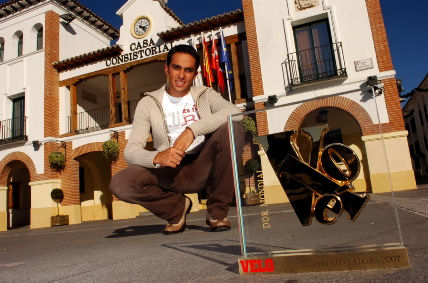
Contador in 2007 with the Velo d'Or (Velo)
SUCCESSFUL SURGERY FOR CONTADOR
November 24, 2008
Alberto Contador has come through surgery successfully today, after spending about two hours on the operating table in Madrid’s Ramón y Cajal hospital.
Surgeons corrected the deviated septum, and after a thorough exploration of his vocal cords, opted out of removing the small nodule previously detected.
According to Contador’s brother Fran, “The doctors considered that the scar produced by removing the nodule would be more harmful, so they’ve recommended a conservative treatment, including work with a speech therapist to correct his speech habits as much as possible.” The vocal cords will benefit from improved breathing, thanks to the repaired nasal septum.
Contador will stay in the hospital overnight, and is expected to be discharged tomorrow. He will retain an uncomfortable drainage tube in his nose for a least a couple of days. However, today’s successful surgery assures that he will be fit to attend Astana’s training camp in Tenerife, beginning November 30. (Contador press room)
IT'S SURGERY FOR CONTADOR
November 23, 2008
Alberto Contador will undergo surgery on Monday to correct a deviated nasal septum and to remove a polyp from his vocal cords. The operation will last about two hours, and will take place at Ramón y Cajal Hospital in Madrid.
Contador explains, “As the result of a crash—I think it was the one in the Giro—I hammered my glasses into my nose, and although I didn’t think the haematoma was important at the time, since then I’ve noticed a certain discomfort in breathing."
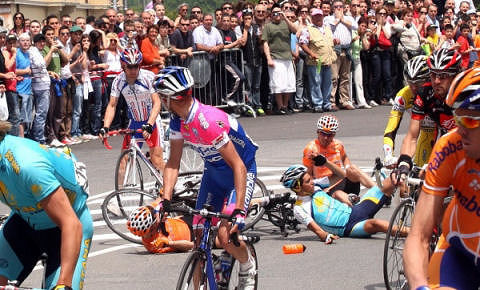
Photo: Contador's crash in Stage 8 of the Giro may have had far-reaching effects. (Graham Watson/VeloNews)
"After an exam, the doctors found a deviation of the nasal septum on the right that doesn’t allow me to breathe properly, so I need surgery. Also, I’ve had problems for more than a year with hoarseness and losing my voice. The doctors found a polyp on the vocal cords that needs to taken out.”
The most annoying part of the operation will be the recovery. Contador will be forced to rest his throat completely for a few days, and won’t be able to speak. It will be “uncomfortable, plus it will keep me from training during the stay at Tenerife. When I get back on the bike will depend on how I improve, but my thought is to use the time in Tenerife to do specific work in the gym.”
At any rate, Contador is ultimately not worried about the current health issues, since he doesn’t think they will have much effect on his program. “I might be behind in my preparation for a couple of weeks, but it’s not that important.
"So far this winter, I’ve been walking a lot and devoting time to resting and recovering from the jam-packed season. There’s enough time to prepare for a good start in my first race, which will probably be the Vuelta a Valencia.”(Contador press room)
DOCTORS SAY NO BIKE AT TENERIFE
November 22, 2008
Chema Bermejo of AS.com writes Alberto Contador will spend Monday in surgery at a Madrid hospital, where he will undergo two operations: a correction of the nasal septum and the removal of a polyp from his throat.
The triple champion from Pinto isn’t sure if the problem with his nose was caused “in the crash during the Giro or in a later one before the Vuelta a España.”
“Since then I haven’t been breathing well. I don’t know if anybody noticed that I raced with a plaster on my nose in the hardest stages of the Vuelta.”
Concerning the polyp, he said, “Every time I’m hoarser and speaking is more difficult."
“I wanted to fix these little details a long time ago, but all the demands on my time kept me from it. It can’t wait any longer.”
“I'm not going to be able to train in Tenerife with my teammates (at the beginning of December). The surgery will mean postponing my preparation for a couple of weeks. I’ll come to my first dates a little under-prepared, but there won’t be any significant effects.”
CONTADOR TRIMS SECONDS FOR CRONO
November 12, 2008
Alberto Contador’s wind tunnel tests suggest that a more forward position on the handlebars would net him better results in the time trial, and could earn him vital seconds next July.
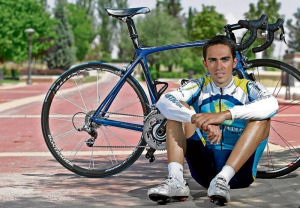 Chema Bermejo of As.com writes - Alberto Contador has returned very pleased from wind tunnel tests in San Diego, California.
The winner of the Tour, Giro, and Vuelta spent all morning last Thursday laboring in three or five-minute intervals against the tunnel’s windstream.
These experiments with different positions on the handlebars and various measurements in his situation on the saddle were all done to determine Contador's best aerodynamic position.
“They processed the data, and the result was that I can still improve by positioning the body a bit farther forward,” comments Contador, who is convinced that scientific advances can make him a better cyclist.
“I already verified it this past year. We tried it on the track, also with different positions. After those tests I assumed another position for the time trials, and the results in this last season were evident.”
Improvements.
“It’s clear that the secret to winning a grand tour is functioning as well as possible in both the mountains and the time trials. Lately the grand tours have been decided by mere seconds, and small advantages can make or break a victory,” adds the triple champion, for whom the Giro company has made a more aerodynamic helmet, “much improved,” for racing against the clock.
El Pistolero de Pinto will now experiment to find out whether the suggested position is actually the best in practice. “It’s the best position for overcoming air resistance, but now I have to see if it can be the best at developing my power over the course of an hour's ride. If it’s too uncomfortable to pedal, that can be counterproductive.”
Armstrong, who will be Alberto’s teammate at Astana next season, was also in the same wind tunnel the day before. “Our times there didn’t coincide. But I hope to speak with him at the end of this month during the team training camp at Tenerife.”
At any rate, Contador seems to have erased his earlier doubts about Armstrong’s arrival. “In the end, I think that the reinforcement of Armstrong is going to be positive. He still hasn’t decided if he’s going to ride the Tour, but if he comes, I still don’t believe that determines conditions.The race will be the judge. And what’s clear is that having him there will relieve the pressure on me. The media buzz will follow him.”
Contador hasn’t yet made his final calendar choices either. “My objective this season will be the Tour, but I haven’t ruled out the Vuelta. I have good memories of this year. It will depend on how the year develops.”
Photo: Contador, out of the wind (Felipe Sevillano)
TOUR DE FRANCE 2009 PRESENTATION
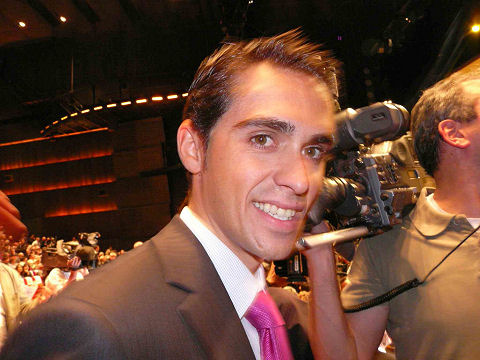
Alberto sends a greeting from the presentation to fans who read the Notebook (Christine Kahane)
Christine Kahane attended the presentation ceremony for next year's Tour on Wednesday. She writes:
Johan Bruyneel, Alain Gallopin, and Alberto Contador were among the last to arrive. They were staying at a hotel located on the other side of the street and were waiting for the last minute, when everybody would already be seated, as they knew Alberto’s arrival would draw a crowd.
See her report and photos HERE.
Contador says "It’s a comprehensive parcours"
October 22, 2008 Alberto Contador was the only official representative of Astana to attend today’s presentation of the 2009 Tour. He commented that it’s “comprehensive, different from past years in that the penultimate stage is at Mont Ventoux, and not the usual time trial.”
About the parcours, he pointed out that the time trial on the first day might be “a good one for me because of the length. The same is true of the team time trial in the fourth stage, where we can tap the potential of the entire Astana team.” He also looks favorably on the last time trial, a 40-kilometer stage. “It’s not very long and it’s better suited to my characteristics than one of 55 kilometers.”
As for the mountains, he underscored the fact that there are “only three uphill finishes, one at Andorra, at Ordino, which I’ll have to go and see. Ditto for the Alps, at Verbier, which is new to the Tour. I’ve got to study those finishes to see how difficult it will be to get ahead.
"When we get to Mont Ventoux I think that the overall classification will already be set, although that climb always means a possible shake-up in the GC.”
Contador isn’t sure that three summit finishes will be enough; it all depends on how well he can take advantage of them. “That’s the key, using them to advantage, the way it worked out in the Vuelta a España, where the Andorra stages weren’t too difficult.
"I hope this parcours will be a good one for me. I hope I’ve got good legs and can adapt to the parcours, because in the Tour the strongest man always wins, and it’s always a tough race. I want to make the best of use of opportunities.”
Finally, Contador was glad that the Tour will visit Spain. “I’m very happy with the stages in Catalunya because I’ll be at home for two days, and it’s always a pure joy to meet up with the Spanish fans.”
ALBERTO AERO
November 6, 2008
Contador hones his aerodynamics in the wind tunnel
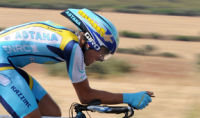 After a visit on Tuesday to the offices of Giro, supplier of the Astana team’s helmets, and having survived US election-day madness, Alberto Contador worked out in the wind tunnel in San Diego with the aim of improving his aerodynamic position on the bicycle.
His tunnel-testing came one day after Lance Armstrong had done the same on Tuesday. Contador was accompanied by Levi Leipheimer, the third Astana rider sent to San Diego.
“Races can be won or lost by a whisker, and I still have plenty of room for improvement against the clock,” he said when leaving Spain for California early in the week. “I’ve noticed big improvement, and for that reason I want to continue to pursue this line.”
Wednesday, three years after his first aerodynamic test session at Boston’s MIT (Massachusetts Institue of Technology) during his Liberty-Seguros days, Contador entered the Low Speed Wind Tunnel (LSWT) at Allied Aerospace Industries of San Diego.
With these tests, Contador has established a base line which will be used to track future development. (Contador press room)
(Photo: Diego Tuson/AFP/Getty Images)
CONTADOR WIND-TUNNEL TESTING
November 3, 2008
Alberto Contador is bound for the USA, to visit the wind tunnel in San Diego in search of aerodynamic improvements to his output in the time trial.
During the 2008 season, the winner of the Tour, Giro, and Vuelta had already effected change for the better in his position on the bicycle, which had produced tangible results.
“We’re looking for a more extended position on the the bike and to modify the contact with the handlebars. I’ve noticed a big improvement,” Alberto admitted, “and for that reason I want to continue to pursue this line.”
The focus of the work in the wind tunnel will be improving the bicycle and “designing a new time trial helmet,” says Contador.
“We’re going to work with my sponsors for next season, Trek and Giro. I’m especially movtivated, because races can be won or lost by a whisker, and I still have plenty of room for improvement against the clock.” (Contador press room)
MONT VENTOUX: A TERRIBLE MENTAL TEST
November 3, 2008
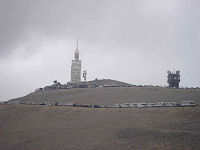 According to Alberto Contador, the penultimate stage of the 2009 Tour de France, with its ascent of Mont Ventoux, will be a rigorous test for any leader.
“I like this Tour de France,” Contador said to journalists during the presentation ceremony in Paris.
“Really, I think it will all be decided before Mont Ventoux, but whoever has the yellow jersey then will be under terrible pressure. Mentally, it will be extremely tough.”
The winner of the Tour de France is usually decided in the last time trial, but next year the ITT will take place in Stage 18 of the 21-stage race.
In the next-to-last stage, the peloton will have to scale the intimidating Mont Ventoux, a climb with an average gradient of 7.6 percent over 21.2 km, on a day that could hurt even the best of the climbers.
“The more I look at the route, the more I like it. The individual time trials are shorter than usual and I won’t lose much time,” Contador said.
"There's also a fantastic finish in Barcelona (Stage 6) that I'm dreaming about, on the summit of Montjuïc
where I won* when I was young. To do it again would be fantastic." (Julien Pretot, Reuters)
*In 2002, Alberto won the Escalada de Montjuïc in the Elite Sub-23 category, at the age of 20.
Photo: Mont Ventoux in 2007 (Christine Kahane)
INDURÁIN OPTIMISTIC ABOUT ASTANA
October 31, 2008
“There’s pleny of room in the calendar, the team is well-organized, and Bruyneel is a good director”
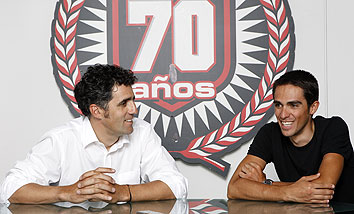 Induráin thinks that Contador and Armstrong can coexist at Astana
Former Spanish cyclist and five-time Tour de France winner Miguel Induráin stresses that 2008 has been a great year for Spanish cycling.
He insists that Lance Armstrong and Alberto Contador “can coexist” at Astana.
“It’s been a great year for Spanish cycling. The three grand tours have been won by different riders with different styles. This shows that we’re represented in cycling in every respect,” Induráin told Europa Press at the opening of the first meeting of the Council of Dignitaries of Spanish Sport (Consejo de Notables del Deporte Español), a new organization in which Induráin takes part.
The ex-rider also talked about the latest sensation, Lance Armstrong’s return. “Nobody has returned after retiring and we’ll see how it develops after three years of inactivity,” he said, noting that cycling is a “demanding” sport, but that the American “knows where he is and what he’s doing.”
Referring to the compatibility of the Texan and Spaniard Alberto Contador at Astana, Indurain thinks that “they can coexist on the same team.”
“There’s plenty of room in the calendar, and their team is well-organized, and I believe that, yes, because Johan Bruyneel is a good director, they can do it well,” he emphasized.
Induráin spoke otherwise about the first meeting of the new Council.
“The meeting today was to launch the project, and to see what we want to do. It’s a good idea, intended to give another opinion about where Spanish sport is going,” he added. (MARCA)
Photo: Induráin and Contador (MARCA)
CONTADOR INJURED IN CRITERIUM
November 17, 2008
Alberto Contador crashed badly in a criterium near Madrid on Sunday. With bruises all down his left side, the world's leading stage racer was taken to hospital for a full-scale check-up before being given the all-clear.
The Tour, Giro and Vuelta winner fell during the criterium's points event, badly bruising his left side, left shoulder and and the left side of his face.
Fortunately the check-up at a nearby hospital showed that the injuries were spectacular but not serious long-term and Contador was back home by the early evening.
Contador's accident cast a shadow over the criterium, a yearly event held by the Spanish Association of Professional Cyclists. Other top riders taking part in this year's edition included Carlos Sastre (CSC-Saxo Bank), Alejandro Valverde (Caisse D'Epargne) and Samuel Sanchez (Euskaltel-Euskadi).
The star of the race was meant to be Juan Llaneras, the Olympic track star who is retiring at the end of the year. But instead Contador's crash became the main event of the day.
“It was a pity, because it looked like being a great day out and instead the party ended badly,” Contador's brother Fran told Spanish newspaper El Mundo.
Contador is due to travel to Tenerife on November 30th for Astana's first training camp of 2009. During the nine-day camp he will have his first face-to-face meeting with new team member Lance Armstrong. (Alisdair Fotheringham, Cycling Weekly)
ITALIAN LIFETIME SANCTIONS GO TOO FAR
October 28, 2008
as.com reports Alberto Contador spoke to the press Sunday while attending the VI Fiesta de la Bicicleta in Derio (Basque Country). The children’s event saw the triple champion, described as having “a special charisma,” riding alongside Samu Sámchez and a cicloturista group of 3,000.
The Italian riders have proposed lifetime sanctions to the UCI for serious cases of doping. How does that seem to you?
That might be a bit much. It’s important to know how to distinguish one case from another. A serious case is one thing, but it’s another matter to be taking a flu remedy without knowing it can give a positive. You’ve got to be able to tell the difference in order to assign punishment, and that’s complicated. Maybe it would apply to some cases but have nothing to do with others. A law like this must be well thought-out.
Basso’s back.
Another great rider. He hasn’t let anything slide, he’s been training from the very moment he left the bicycle. You can bet he’ll be at the highest level.
Do the changes in the Tour route make it more suitable for you?
Change is good whenever you’ve got the legs. The Tour is always tough. It’s very bold to say that this is the Tour de Contador. The Tour is very difficult, and you never know who will turn out to be the best. That’s why fewer miles against the clock is a plus for me.
There are fewer summit finishes, that’s a fact.
Yes, and I’ve got to take advantage of them. The cycling is more equal each time. There are fewer miles against the clock but also fewer chances to get a margin.
Is the Tour your main goal for next season?
Yes. After winning the Giro and the Vuelta this year, I’d like to go back to the Tour and fight for the victory.
How are things in light of all the commotion surrounding Armstrong’s return to Astana?
I’m calmer, better off. I’m glad to share the team with Lance Armstrong. He’s a rider I’ve always admired, and I admire him because he’s one of the greatest champions. I’m glad to share the team with him. This controversy has been blown out of proportion, it doesn’t exist, and I want it settled. I’m looking forward to the beginning of training camp in November.
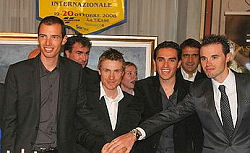
ALBERTO TO LA GAZZETTA
October 21, 2008
Alberto Contador, the reigning Giro d'Italia champion, is in Italy today to attend a press gala promoting the 92nd edition of Italy's grand tour (2009).
Speaking as a Tour winner who experienced disbelief and bitter disappointment when barred from defending his title last year, he showed an empathetic attitude toward Lance Armstrong, who may not receive a warm welcome to the Tour de France in 2009.
Contador told La Gazzetto dello Sport that he “can’t imagine” that his new teammate, Lance Armstrong, “doesn’t want to participate in the Tour,” in spite of the American’s recent qualms about riding in a grand tour whose organizers see his participation as problematic.
Among other topics covered in the interview, Alberto stressed that although there were prominent doping cases in 2008, like that of Riccardo Riccó, he believes that the majority of riders can be counted on to comply with controls.
Asked about the return of Italian rider Ivan Basso after a two-year suspension, he replied that it was “good news. Ivan is a talented rider, he has strengths. He made a mistake, he paid for it, and now he’s coming back. That’s some justice.”
Contador also explained that he’d like to take part in races like the Fleche Wallone or Liége-Bastogne-Liége, which he described as the “most complete overall,” as well as in the World Championships, “if they do one for climbers, like in Duitama (Colombia) in 1995.”
He also stated that he still needs to improve, and indicated that he has been able to distinguish himself thanks to his ability to recover after an effort, and to his mental ability.
“I know that it’s possible for me to define an era in cycling. Doing that will be complicated, but just to think that I could do it is an enormous challenge that I really like.”
VIDEO HIGHLIGHTS
Photo: Ballan, Cunego, Contador, and Sanchez attend presentation gala (La Gazzetta dello Sport)
ALBERTO CONTADOR: "I'M STAYING WITH ASTANA"
October 18, 2008
While he rests and rebuilds strength for next season, Alberto Contador has resolved any doubts about his immediate future. He’s very happy to state that he will stay with the Astana team, where he hopes to be able to share the spoils of victory with Lance Armstrong and the rest of his teammates.
After a few weeks of reflection at the end of the season, what are Alberto Contador’s plans for next year?
I’ve been examining different scenarios and alternatives proposed since the middle of the Vuelta. After getting back together with my director, Johan Bruyneel, having talked about what’s happened during these last couple of months and about some articles that have been published, we’ve resolved any tension that existed between us. We’ve already talked about my calendar for next year.
Consequently, I can state that next year I will stay with Astana. I’ve decided to stay because I believe it’s the right thing to do. Here I can count on an extraordinary group of supergregarios, who have turned themselves inside out for me in every race. This will surely allow me to keep fighting for victories with the very best chance of success.
Have you gotten over your reservations about Armstrong’s arrival at the team?
I believe that everything will work out far better than it seemed at first. If we each have our own calendar there will be no kind of problem or drawback.
For me, it’s a pleasure to work together in the same team with a rider that I’ve always admired. Also, it’s no secret that I’m ambitious, and considering that he wanted to win his eighth Tour, I thought that coexistence would be complicated. But I believe that with good team management there will be no problems in France. As for the rest of the year, there are no disadvantages for me.
Do you already know where you’ll race together?
We still haven’t finalized our calendars, although I’ve asked Johan for one similar to 2007. We’ll have a team training camp in California in January, and we’ll look it over then. It’s possible that I’ll start the season in Valencia, then do Paris-Nice—a race that I really like. It’s almost certain that I’ll ride Castilla y León and País Vasco right after that, although for the latter we’ll have to see how I recover, because the season’s first block of racing will be long. After that, we’ll consider the rest of the season.
Is it already clear that you’ll ride only one three-week race?
I can’t say for sure, but my idea is to ride only the Tour and to give it 100%, because this year recovering from the effort of the Giro and the Vuelta cost me. At my age it’s better to compete in only one grand tour, and not punish the body too much.
Have you spoken to Lance Armstrong about plans for next year?
We’ve tentatively scheduled a training camp in Tenerife at the end of November where we’ll speak to our directors, hopefully to avoid any controversies, because there’s an intense feeling of expectation so far, which is understandable. We’re just going to be two more guys on the team, and as far as I’m concerned there will be no tension.
What do you think about Lance riding the Giro?
I think that he’s made an excellent decision. I rode it last year and it’s truly a rich experience. I had the luck to go there because of circumstances that I didn’t like at the time, but that gave me the chance to enjoy the Italian fans. I think Lance will enjoy that, too. Lance has been wishing that he had ridden the Giro, and he’s great in any race he rides. I think he’ll be very happy in Italy, plus he’ll have serious options for the victory. I don’t know if he’ll be the top favorite, but if I had to place a bet online, I’d gamble on Armstrong.
Do you think that you’ll be able to ride the Tour together without big problems?
First we have to see what happens in the early part of the season. But if the team is well-organized enough, we get there motivated, and if our relationship is comfortable, the mutual incompatibility is not as great as it was thought to be in the beginning. It’s true that I would like to win, of course, but there will be no mutual incompatibily.
What do you think about the possible arrival of Vinokourov?
The possibility is creating a lot of controversy, which for now is premature. We have to wait for the UCI to decide on the matter and simply abide by their decision. Whenever we’ve been on a team together we’ve had a good relationship, and if no one sees a problem in it, he could join the team to no great detriment.
What do you think of the team’s projected roster for next year?
It’s been reduced by a few men, but Astana is the most powerful team in the world for grand tours. Armstrong will bring a great deal to the Giro, and he’ll offer us his terrific experience as well. There could be nothing better than learning how to control a race from someone like him. And don’t forget Leipheimer and Klöden.
Words cannot express. When you see Astana at the start line, the first thing you’ll think is “Good Lord, what a team!” We have a group of riders that knows how to do incredible work.
In addition to that, reinforcements have arrived, like Haimar Zubeldia. I’ve already spoken to him, and he’s very excited. He already knows what it’s like to be at the front in the Tour, and he’ll be able to play an important role. Finally, some young guys like Jesús Hernandez have arrived, who will be able to make a great leap in quality.
CONTADOR: CELEBRITY TEAMMATE NO PROBLEM
October 15, 2008
Alberto Contador, winner of the Giro d’Italia and Vuelta a España 2008, has told MARCA that he’s not worried that Lance Armstrong, who will be his teammate at Astana following the American’s decision to return to competition, is more famous.
In fact he has said that “in some ways it’s good.”
“We’ve already talked about each of us. At the level of his victories, I’ve been impressed, and it’s clear that in terms of celebrity, Armstrong is in a league of his own.
"But I’m not worried about it, and anyway, I don’t like to be the center of attention all the time. You need to have plenty of recovery time, and in some ways it’s good,” he said after riding the Criterium de Pamplona.
Contador, besieged by fans during the race in Pamplona, commented that he’s comfortable with popularity. “I accept it very well, because if it weren’t for the fans, none of this would exist. I’m glad to satisfy everybody, although it’s not always possible,” he said.
He amitted that he has set the mark very high for next year, and clarified that one of the keys to success is self-discpline.
“I’m expected to win, but I know that’s not always possible. I will fight to win, but if I don’t, I don’t beat myself up. If I don’t demand it of myself to win, I won’t,” he emphasized.
When asked about his future, he said, “I still have two years on my contract with Astana, and I will fulfill them.”
CONTADOR'S BAND
October 10, 2009
 "Yo quiero ser cómo tú,
vivir a contrarreloj,
"Yo quiero ser cómo tú,
vivir a contrarreloj,
quiero ponerme el maillot,
como Contador,
y ganar este Tour"
"I wanna be like you,
I wanna live the time trial,
I wanna wear the maillot,
just like Contador,
I wanna win the Tour."
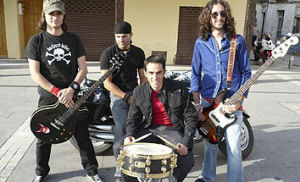
These are the lyrics from the refrain of “Yo quiero ser cómo tú” (“I wanna be like you”), a song tribute for Pinto’s champion, Alberto Contador, by the group Mama Kids.
Mama Kids’ lead man Marti explains, “They always produce songs to go along with great accomplishments in football and basketball. But there’s almost never one for cycling. That’s why after Contador’s victory in the Giro we jumped on the chance to compose this one.”
Individually, the members of the group have been playing concerts around Spain for a decade, “although as Mama Kids we’ve only been together for four years.” The three musicians share not only their hometown with Alberto Contador, but also a common goal of stirring up excitement in the public.
“People like Contador’s song,” explain Chava and Boti, Mama Kids’ bass player and drummer. “In the concerts we’ve done lately, like for instance in Asturias and Aranjuez, we saved the song for last, and all the people ended up singing along because the refrain is so contagious.”
Contador, who’s currently considering certain questions about his future, came along with his brother Fran to meet with the band, and took a moment to get the feel of the guitar and drums.
The season is nearly over, and he’s currently not riding the bicycle much, but he still has a pair of commitments ahead: a criterium at Pamplona—a tribute to José Joaquin Perez de Obanos, the friend of Echávarri and Unzúe who died in the Spanair crash—and the ACP Criterium in Boadilla del Monte, tenatively set for November 16. (MARCA)
Photo: A new beat for Alberto Contador with Mama Kids? (MARCA)
IN THE PRESS
October 9, 2008
According to Reuters today, Alberto Contador is more relaxed now about the arrival of Armstrong at Astana.
“I don’t like controversy. I must look out after my own interests, clearly, but I have a contract for two more years with the Astana team and although it’s not impossible to break a contract, it's not easy, either.”
When questioned about Johan Bruyneel’s position on which rider the team will work harder for, Contador said, “It’s extra motivation. I’ve got to try to be better than Armstrong, period. I’ve got to try to be stronger.”
According the the report, Contador acknowledges that he is now “more temperate” in his speech.
A SONG FOR ALBERTO
Septebmer 27, 2008
Music and cycling, Italy’s two loves.
Roberto Cantoni would agree. The Italian cancer patient combines his two passions to give him strength and inspiration, and to encourage others.
Cantoni has composed a song in honor of Alberto Contador, whose example has helped him to keep fighting. Currently looking for a sponsor, he hopes he can share his work with the world, and so play a small role in defeating the disease.
Cantoni has struggled with cancer for years, and says that he has survived “thanks to God and chemotherapy.” He became fascinated by Contador after the Giro triumph last June.
“I identify closely with Alberto because he also fought against death when he had a cavernoma, and since then he’s been able to reach the highest point in cycling. Plus, he represents the image of clean cycling,” the song-writer says.
So far Cantoni hasn’t gotten the sponsor he needs to fufill his mission. But on Thursday night, his work succeeded at another level in Varese when he performed his song for the Spanish team.
Oscar Freire played the role of impresario. Having spoken with Cantoni in advance, the three-time world champion gathered the team after dinner in a hotel room where they heard a live performance of the song for Contador. Cantoni’s wife and daughter, a Giro hostess, were also part of the audience.
Cantoni accompanied himself on the guitar, unable to hide the joy he felt at offering the spontaneous gift to Contador, his inspiration.
Thanks to mobile phones and the latest technology, Valverde and other members of the Spanish team recorded the song, which has become a sort of anthem for the Spanish selection at the World Championships in Varese.(MARCA)
MIGUELÓN: CONTADOR IS THE BEST RIDER ON THE PLANET
September 25, 2008
 Miguel Induráin showed his doubts about the presence of Alberto Contador and Lance Armstrong together on Astana if both “are at the same level,” and he thinks that the Madrileño would find “things a bit tricky.”
“If they’re at the same level, I don’t believe they’ll be able to share a team. In addition, this being Armstrong, I believe things would be a bit tricky for Alberto, but he and his team will have to consider it carefully."
"Lance is a celebrity, and to ride alongside him in a team is a bit complicated,” explained Indurain on the program "Al Primer Toque," on Onda Cero Radio.
Nevertheless, Induráin knows that the rider from Pinto “is the best rider on the planet,” but warned that it would be another story if the American reaches his previous level and can go mano a mano with him,” he emphasized.
“Let’s see how he copes with Armstrong’s comeback, but if they don’t alter the grand tour routes, and maintain the mountains, he can get a long list of victories. Alberto has a great future ahead of him”.
Surprised by Armstrong’s return
Induráin acknowledged that he was “a little surprised” by the return of the Texan, whom he sees as strongly supported.
”You can see that he moves in high circles. He’s with Bill Clinton, he’s very well-connected at the international level and has the backing of the mass media, who support his cause,” commented the five-time Tour winner, who knows that the American has “great popularity” due to his victories in Le Grand Boucle and in overcoming cancer.
Induráin also isn’t clear if Armstrong “will be at the same level” of the days before his retirement, but he’s sure that in the event that he reaches “a slightly lower level, it will still be very high.”
“He’s a great fighter and has always had a very strong physique so at a bit under par he’ll still be very good,” he clarified.
He thinks that the American has a lot to lose. “He has plenty to lose in that respect because he left when he was at the highest level. He left winning the Tour and if he doesn’t finish among the best, there’ll be many disappointed people.
"Those of us who know how difficult it is, we must applaud his desire and his effort, but we see him as a winner. If he has a bad year, it would be difficult to comprehend,” he confessed. (MARCA)
Photo by Hermann Krausse
CONTADOR: I'M DREAMING OF THE VUELTA
August 28, 2008
Pinto’s hero confidently eyes the prize
EFE - Madrid - 25/08/2008
Alberto Contador (Pinto, 1982) wraps up training in the Sierra de Madrid ready to face a major challenge: On Saturday in Granada he’ll begin his battle to become the first Spanish cyclist in history to win all three grand tours.
Contador, the winner of the 2007 Tour and the 2008 Giro d’Italia, told EFE in an interview that he’s starting the Vuelta with both body and mind in form. He’s ready to fight for a race that gives him special motivation, where he'll share top billing with reigning Tour winner, Carlos Sastre, whom he considers the prime candidate for the title.
Having missed a medal in Beijing by a mere eight seconds, in the Vuelta he’ll seek gold again. This time Contador hopes to join legends like Anquetil, Merckx, and Gimondi—the three cyclists with the best palmarés among stage racers.
In your last race, the Clásica a los Puertos, you looked tough and aggressive, and it’s no secret that your hopes are set on the Vuelta. How will you begin this edition?
I dream about the Vuelta. I really want to do something great and will try to do well in the GC, but it’ll be difficult to win because the level is very high. I feel good, but we’ll see what level I show at the Vuelta.
I’m starting confidently: the last test was good and every day I get better. I think I’ll get there in a very good moment of form. You never know, of course, but my physical and psychological states are very good.
In addition, you’re bringing the best possible team, including names like Leipheimer and Klöden, men with results and experience. The former won the bronze in Beijing.
Having the support of Leipheimer and Klöden gets rid of a lot of the responsibility and pressure on me, so I can be more relaxed from the beginnng. It’s an honor to have these riders on the team, but I also have complete confidence in the entire group.
After getting fourth at the Olympics, the Vuelta is only worth gold.
A silver medal wouldn’t be bad either, but I am thinking about the overall. It’ll be difficult to win; nobody thinks it will be easy, but I will try.
In principle, you won’t have a lot of chances to ride the Vuelta and win. You’re a Tour man, and your future goals will be directed toward the Tour de France.
Yeah, who knows. This year I’m doing the Giro and the Vuelta and at the moment I’m happy with how it’s working out. I guarantee that my target in the future will be the Tour de France, but I’ll never count out the Vuelta. I’ll always have it in the back of my mind.
You’ll have rivals among your compañeros: Sastre, Valverde.
I think the likeliest candidates to win are Sastre, Valverde, and even Leipheimer, but many names will crop up. Carlos Sastre is the number one favorite because he proved his level in the Tour de France.
Obviously, having not participated in the Tour, you’ll arrive fresher than they will.
Everybody knows how hard they’ve worked. I was really worn out after the Giro, then I recovered, but the truth is that the people who rode the Tour will be more fatigued than I am.
Do you aspire to become the first Spaniard to win all three grand tours?
Absolutely, that’s something that motivates me. It would be a dream come true to make history for that reason. I’ve always said I’d like to win the Vuelta, if not this year, another year. But certainly, I’m shooting for it now.
There’s nothing wrong with the route, with five mountaintop finishes and not much racing against the clock. Plus there’s the incentive of the Anglíru, the most feared peak in the Vuelta.
If I feel good, the finish on top of the Anglíru will suit me really well, but the question is whether or not I’ll feel strong enough on that exact day, because it could be an important stage to gain time.
You climbed the Mortirolo in the Giro and studied the Anglíru in July. Are they anything alike?
The Anglíru could be the Spanish Mortirolo, but it’s different because the Mortirolo has a steady gradient, very hard throughout the climb, and the Anglíru has varying gradients with a level zone in the last 1,500 meters. However, it has five deadly kilometers, with an incline that seems to go on forever.
It’ll be a beautiful and spectacular stage for the spectator. It’s good that the organization has included stages like this.
What are the keys to the race?
The key will be to avoid losing too much time in the time trials and to try to go day by day and arrive fresh in Asturias, where the general classification will already have taken shape. The uphill time trial at Navacerrada could be a good time to finish it off.
Cycling is in a state of euphoria. What do you say about the role of the sport in Beijing?
Spain’s performance was superb. It’s a pity that we couldn’t come away with another medal in the time trial. Joan Llaneras was impressive. They ought to build a monument to that man, because he deserves it. The most distinguished Spanish athlete at the Games.
Can you say something about this key moment in cycling after several years of difficulties?
It’s a great moment, to see if it’s true that the sponsors and the public show a new enthusiasm. Cycling is in a good place, and must get better.
Alberto Contador leaves for Granada Wednesday, 27 August, where he hopes to begin another outstanding chapter in his career. The youngest Spanish Tour de France winner finishes training camp in the Sierra de Madrid, honng the form that will make him the main character in the Vuelta a España story, starting Saturday.
EIGHT SECONDS FROM BRONZE
August 19, 2008
This story by Marcos Lopez has appeared in numerous Spanish periodicals. We present it here with translation help from Christine Kahane.
Thursday, August 14, 2008—He left one room yesterday and entered another. Without a medal on his neck.
One hour after finishing the time trial, in which Fabian Cancellara of Swizterland flew towards Olympic gold, Alberto Contador was at the foot of the Great Wall of China, passing antidoping controls. First blood tests, then urine. A short distance from the Giro winner was the more youthful figure of Samu Sanchez, taking photos with his digital camera, capturing his last impressions of Beijing, the city that raised him to the top last Saturday.
The race in which Contador missed a medal by a mere eight seconds was devasted first by the cyclone Cancellara–sometimes prophecies are fulfilled–then by Gustav Larsson, a Swedish rider signed last year by CSC, Carlos Sastre’s team.
The little-known Swede won the silver. “I couldn’t put a face with that name,” said Samu, illustrating the stir Larsson caused among the favorites.
From Better to Worse
While Contador killed time before urine analysis, he reviewed the race mentally. He started fast, was best at the first intermediate check, and became the virtual gold medalist.
Later, everything that he had won in the ascent, he lost on the descent.
“Alberto went as fast as 80 kilometers an hour, imagine how fast sprinters go,” said Paco Antequera, the Spanish selector. “They were the superiors, they spoiled our party.”
“That’s the plain truth, but it’s not so bad,” Sanchez explained, who was only sorry that because he was the first of this select group to begin, he was never compared to the favorites in the time checks.
The Wicked Descent
The Asturian said it with an effusive hug for Cancellara, the model of a rider. Or the rider who didn’t want to be a model. The fastest in the world, one of the best time trial specialists that Sanchez can remember, because he has the advantage of his bulk and powerful legs in gaining seconds. While others ride like humans, Fabian rides like an extra-terrestrial, almost faster than is possible.
While he was going downhill on the Great Wall, Contador was not alone. “I’m sorry to Spain, who wanted another medal. Also the people of Pinto cheered for me in the Plaza de Constitución. I felt them pushing me down the slope, only a little was missing to finish it off,” Contador lamented, still keeping sight of the big picture.
He came to Beijing to add to his extraordinary palmarès (consecutive Tour and Giro, and possibly an unusual triple slam after the Vuelta in a few weeks), but hadn’t made the Olympic TT a definitive goal.
“It’s not my forte, but I’ve demonstrated that every day I improve.”
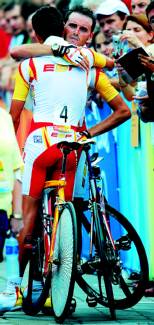 Weight Watchers
It went so well that he only lacked eight seconds, the time it takes to sigh, to be in the top three and gain the honor of stepping onto the Oympic podium. Or to put it simply, the anonymous Swede surprised him.
“Larsson? He did what? Silver! I don’t even know him,” Contador said, still seated on the bike on the final straight stretch of the circuit, after locking in a long and sincere hug with Sanchez, a touching moment.
“I’m not going to create a stink over not getting bronze,” he said, remembering that “the best in the world were here.” For sure, no one was missing.
When the road zoomed upward, Contador had the virtual medal on his chest. When the road plunged, he tried valiantly, but couldn’t hold on.
Samu, too. “If the ascent had been harder, it would have gone far better,” the winner of the road race commented. “If you look at the weight and musculature of each rider, there’s the explanation,” he pointed out.
Contador, who abandoned the road race, also suffered two blows to the knee. Add these factors to the different physical characteristics of the riders--the lightweight Spaniards vs. the extraordinary physique of a powerful Cancellara (1.86 meters tall, weighing 80 kilos) and the longeline of Larsson (1.95m, 77 kilos)--to explain how the medal got away.
Inspiration from Spartacus
Contador was fourth, inches from the craze of an Olympic podium, even though—remember—he’s a climber. He’s not like Spartacus, as Cancellara is known to his team. The Swiss gladiator earned his country it’s first Olympic gold in Beijing. A cyclist disguised as a human locomotive, who found the necessary motivation in the sumptuous scenery along the route.
“The Wall has given me the power and the force. When you see that it’s more than 5,000 kilometers long and the immense effort required (to build it), you think, “Maybe it’s a sign.”
“That’s how hard I had to work,” said Cancellara, who collapsed in exhaustion at the end. He crossed the goal, threw down his bike, was corralled by the media, and cried out for air.
Pure air for the best rider, while Sanchez joked about the dinner (ed.—the prize ham awarded to Sanchez along with the gold medal, not transportable to Spain) that awaited them last night in the Olympic Village: “One thing’s for sure: tonight we’re eating ham!”
A hug from Sanchez after the TT (photo Jordi Cotrina)
BEIJING, THE WEB, AND LA VUELTA
August 18, 2008
Alberto Contador got home from Beijing on Thursday with one thing on his mind. The Vuelta a España starts in two weeks, hot on the heels of the Olympic Games. Thanks to an initial test of form in Beijing, Contador knows that when the peloton leaves the gate in Granada, he'll be ready to win.
He gets fans up-to-date in this interview for his new official website, albertocontador.es .
Did you like your experience at the Olympic Games?
Yes, it was very beautiful. Every athlete wants to be in the Olympics at least once in his life, because it's a privilege few can have. Being in the Olympic Village with the best athletes in the world is something that we want to be able to enjoy.
What conclusions have you drawn about finishing fourth in the time trial? Will you return in four years for the gold medal?
My conclusions are very good. I'm happy with the result, since my physical condition was not the best. I worked very hard and squeezed every ounce of potential from my body, although I was deflated at the end.
I can see that my preparation for the Vuelta a España is on target and that I've improved enormously in the time trial, which gives me peace of mind regarding the other climbers. I need to fine-tune my form, but I believe that I can arrive at the Vuelta in very good shape.
Will you want to go back to the next Olympic Games?
I would definitely like to return for a triumph, but that's very difficult to do. I believe that in a few more years I should've improved in the time trial and then I'd like to go back to fight for the gold, although I'm not obsessive about that goal. What I know is if I'd ridden the Tour and finished well, I would've gotten a much better result in Beijing.
A controversy has arisen over Levi Leipheimer's time trial bicycle. What do you think of that?
What I would never want is for them to take his medal away and give it to me, because Levi is a colleague and a friend.
Also, I don't believe there's any reason. They've already looked at his bike at other races and if there was something wrong with it, they wouldn't have allowed him to take the start in Beijing. I'm not concerned about it.
When you got back to Madrid, you got the good news that your new website is ready. What do you think about it, what do you expect from it?
I was eager to see it, because the previous one was beautiful and had lots of visitors, but it lacked updates.
Good work has been done and it has very interesting things. I'll write contributions myself when I'm in competition, and we'll have a lot of content.
The best thing I can say is that I hope lots of fans will visit and tell us what they think and how to continue improving it. It's not cool to be without a good website these days, plus I can be in closer contact with fans all over the world.
There are 15 days before the start of the Vuelta. What's your plan?
To get over jet lag and the effort of the race on these first 3 days so that I can start training again.
I also want to scout out the Sierra de Madrid stages, because the team will train at Navacerrada just before the start. Also, I'm going to ride the Clásica a los Puertos to get back into the rhythm of competition.
How do you see yourself before the start of the Vuelta?
Mainly I'm really excited and very motivated to ride to win, because unlike in the Giro or the Tour, here I know the parcours very well and I want to enjoy the Spanish fans.
All this is very important in the month of September, and since I didn't ride the Tour, I believe that I'll be very good physically.
Also, I'm lucky that in this team I'm not under pressure to win. I'll start the race with my duties clear, I'm still very young, plus Leipheimer will ride, and he's another guy that can fight for the general with confidence, plus Klöden will probably come, and his quality makes him another candidate.
The objective is that Astana wins, and we have three very solid tricks up our sleeve.
Will the road choose the leader?
Yes, the road will tell us the best strategy. Astana wants to win, and I'm lucky to have these two teammates with me, because we'll be able to defeat stronger rivals.
Do you believe all the program changes will affect you, as well as having done the Giro?
No, this year hasn't affected me. This year has been an exception, because I won't ride two big tours in the same season again, but I believe that I'm going to arrive fresh, especially mentally.
Will your debut in the Vuelta be lucky, like the Giro?
I don't know, but I'm sure that both knowing the race and my desire to enjoy my country and the Spanish fans will work in my favour.
What will be the key elements of the race?
I think that we have to wait until the end to know the winner, but the first test will be the first 40 km time trial, where some of the favorites might fail.
Then the Pyrenees stages will show proof of each rider's form. After this group of mountains, the big story will be the stages in Asturias - Angliru and Fuentes de Invierno.
Whoever leaves Asturias as leader will have won most of the Vuelta, which only leaves the last test in the Sierra de Madrid and the time trial to Navacerrada to settle things, if the differences are still small.
Is the Vuelta a España for climbers or time trial specialists?
For climbers, although it's not bad either for people who can do well in the TTs, then ride defensively in the mountains.
VUELTA 2008: THE PYRENEES WON'T DECIDE THE RACE
July 13, 2008
Alberto Contador completed a training foray into the Pyrenees Thursday, a visit designed as a study of Stages 7 and 8 of the upcoming Vuelta a España. The expedition to Andorra included Contador’s Asturian teammates Chechu Rubiera, Benjamin Noval, and Dani Navarro, and Sérgio Paulinho of Portugal.
“Yesterday we rode the final 120 km of Stage 7: We climb La Rabassa twice, the second time with an extra four kilometers at the end--a first for the Vuelta. It will be a very difficult stage because of the cumulative kilometers in our legs, especially if it’s hot.
“The first two kilometers of the climb are really hard, but it gets easier after the sixth kilometer. The last part smooths out and there’s a chance to recover a little.”
“In the second part things will be determined by how the legs feel after 200 kilometers. Everything depends on the rhythm set at the beginning of the stage, but the last four km are not as hard, so it stands to reason it will come down to a small group of three or four riders. It will be my first time up this mountain, I only remember it from the year that Zarrabeitia got his finger cut off in the descent.”
On Thursday, Contador and his teammates rode 133 km of Stage 8, from the top of the Puerto del Cantó to the finish at Pla de Beret, reported press manager Jacinto Vidarte.
“El Cantó looked really hard to me. We took our bikes to the top, and after the descent we climbed the Puerto de Enviny, which was no big deal. We went on through a fairly long valley before La Bonaigua, which is tough. Today they were resurfacing the road. We were able to get through, but with 19 km of that plus the heat, it was really difficult," said Contador.
“On the other hand, I was a little disappointed with the Pla de Beret. It’s not very difficult, the road surface is good, and the last one-and-a-half kilometers goes downhill. Nobody will get much of a margin there.”
Alberto has a clear mental picture after these two days of reconnaissance. “In some ways I’m disappointed with the Pyrenees, because if it’s going well, there’s no place to grab the margin that I’d like, and if it’s not going well, you can limit the damages because there will be a lot of chances to get organized and ride defensively."
“These are not mountains for pure climbers. The only danger is that if you’re not on a good day, you could lose the general. But I don’t believe they’ll be decisive in winning the race."
Contador will scout out the mountain stages of Asturias next week, including a climb of the Anglirú on Thursday and the summit of Fuentes de Invierno on Friday. He’s hoping to find a different scenario there.
“Asturias will be much more decisive than the Pyrenees. Some of the favorites will be dropped here, but the real differences in the general will happen there, in Asturias.”
The Vuelta a España 2008 will take place August 30 - September 21.
Visit the Vuelta a España official website for more information about the race.
ROYAL RECOGNITION
July 4, 2008
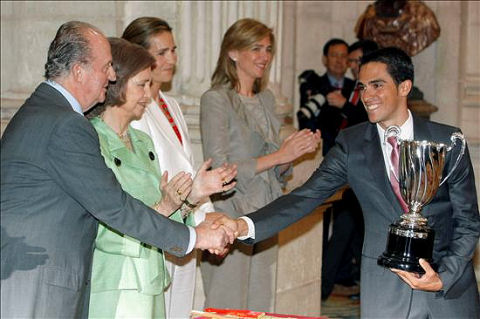
A royal reception in Madrid (EFE)
On Sunday, June 23, Alberto Contador was invited to the Royal Palace of Madrid as a recipient of Spain’s National Prize
for Sport.
According to numerous accounts in the press and the official website of His Majesty Juan Carlos,
the awards ceremony was a shared event by the palace and state dignitaries to recognize athletes and organizations
for outstanding achievement in sport in 2007.
Those assembled at the palace were guests of King Juan Carlos, Queen Sofía, and the princesses Elena and Cristina.
The Prince of Asturias was also to have been present but could not attend due to the death of his mother-in-law.
The royal family hosted the affair in the Hall of Columns, and participated in the ceremonial act of awarding the prizes.
Present were Jaime Lissavetsky, Spain’s Secretary of State for Sport, and other dignitaries, including Madrid’s mayor
Alberto Ruiz-Gallardón, the presidents of the Spanish Olympic Committee and Paralympic Committee, and the
ambassador from Argentina.
The list of honorees featured individual athletes of international prominence like Contador. Prizes were also
give to people who disguished themselves by promoting sportsmanlike conduct, and as marks of international goodwill.
Sportsman of the Year ("Premio Nacional Don Felipe de Borbón") was given to yachtsman Rafael Trujillo Villar,
Sportswoman of the Year (“Premio Reina Sofía”) to middle distance runner Maria Teresa Martinez Jiménez.
Contador was given the prize for Revalation of the Year ("Premio Infanta de España S.A.R. Doña Cristina")
for the spectacular season which culminated in victory in the Tour de France.
Don Juan Carlos concluded with a statement, in which he emphasized that “successes are not improvised.
They are built by much work and much tenacity, with thorough planning and the necessary structures of support
for the athlete.”
He emphasized that the athletes assume the responsibility “to set an example in overcoming difficulties,
therefore encouraging the best virtues of sport. Virtues that spring from the generous and shared common
loyalty of teamwork, discipline and nobility, and the spirit of reaching for ever higher goals. Virtues that are,
for this reason, a basic instrument for the formation and well balanced development of the person, in order
to contribute to solidarity among citizens.”
The king ended by congratulating the awardees, on behalf of the queen and the princesses,
for “the example you have set, and for upholding the image of Spain beyond our borders.”
A reception by the royal family put the finishing touch to the ceremony.
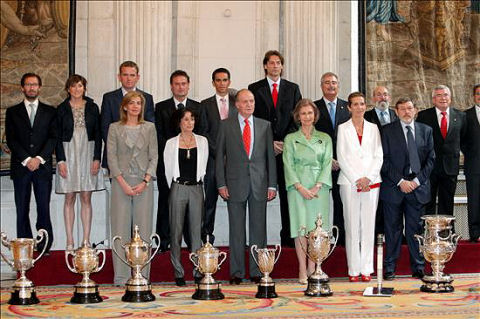
Only the king stands between Alberto Contador and his prize cup (EFE)
EL PAÍS INTERVIEW
June 20, 2008
In a career sweet spot between back-to-back Tour/Giro victories and tackling the Olympics/Vuelta duo,
Alberto talks things over with Carlos Arribas of EL PAÍS.
“People are getting excited again”
Coming home to Pinto, Alberto Contador (1982) says his recent Giro victory has had even more
repercussions than his triumph in the Tour last July. He modestly assumes the role of “messiah,”
the man who has come to save cycling.
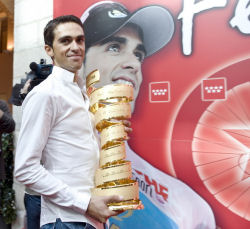 Alberto Contador is on vacation, but it’s almost impossible to find a gap in his schedule.
Between working on his house and accepting invitations for radio and television appearances,
the guy from Pinto has no spare time.
Finally we manage to grab a minute, and sit down on a bench in Egido Park, about 200 meters from his parents’ house,
where he still lives.
The backdrop is the Polideportivo, the multi-purpose athletic pavilion which sports a glistening
label bearing the name Contador. The building displays a gigantic picture of Pinto’s favorite cyclist,
wearing the maglia rosa and holding a golden spiral, the Giro trophy.
From time to time, children approach, recognizing him in spite of his enormous sunglasses.
They’re hunting for autographs. On pink paper, of course.
 When you won the Tour, you weren’t in the middle of such a media whirlwind.
It’s as if the Giro were more important...
When you won the Tour, you weren’t in the middle of such a media whirlwind.
It’s as if the Giro were more important...
 It’s not that it’s had more impact, it’s that it all adds up. After the Tour there was a tremendous commotion, too.
My exclusion from the Tour has been in the news for a long time now. Then, in the Giro, the story about our
invitation was big news, and even though it was only broadcast for three days, it drew a lot of attention.
Much more than the Tour.
Two and a half million Spaniards were watching you live on TV when you crossed the finish line in Milan…
I think that, considering the Giro was only broadcast by Eurosport, all told it was a very high number.
Do you think it was influenced by lack of doping scandals?
No. What influenced it more is that people are getting excited, especially in Spain.
And all over the world. In Italy, the Giro got 44% of the television shares. That’s gargantuan.
They needed a foreign rider to go there and give them a good show. It had been twelve years since a foreigner won.
But people are getting enthusiastic again because they see something new in cycling,
not just that there are no scandals...
Yes, that too, but that's not an obsession. It’s more fun to talk about tactics—who’s going to attack
tomorrow, what the route is like—than to drone on about scandals.
How was this victory significant?
It’s been good for Spanish cycling and world-wide cycling. A race as beautiful as this one,
riders fighting on equal footing …an explosion by one guy on one day, and the next day somebody else…It’s
good for everybody and mainly, for Spain.
All countries, Spain in particular, take their lead from their champions.
If there’s no scandal in the Tour and the Vuelta, it will be really, really good.
There are riders that need a director telling them what to do at every moment, but you go when it feels right…
Yes; in the Giro, I used my own judgement in every stage.
Man, the director always has an influence, but to be perfectly clear here,
I’m the one who knows best how I feel on the bike.
But there wasn't much room to manuever either. We didn’t have such a powerful team that we
could play around with tactical moves. The tactics were always quite simple,
although complex, because handling all the rivals stacked against me was complicated.
The Giro was not won from the car.
Therefore you’re against using the earpiece. In a survey of the union, 70% of the riders were in favor of it.
I’m in favor of it. I know that some say the earpiece kills spectacle,
but I think that, no, it has changed cycling, that everything is more equal and that they’re pleased with the show it makes.
The earpiece has never held me back. If I’ve got legs to attack and think the time is right, I’m not going to hold back.
You’ve got to take advantage of the opportunities. The earpiece is good for breakdowns and other rough times.
In the end, it seems that the Tour has done you a favor: If they hadn’t blackballed you,
you wouldn’t have won the Giro, nor would you ride the Vuelta a España.
In priciple, it always seems that negative things bring about positive things.
The Giro has had more impact than winning two consecutive Tours. I’ve won the Giro and the Tour at 25 years old.
And right now, I’m glad they haven’t invited me to the Tour. I’ll be able to go to the Olympic Games and ride the Vuelta.
If I’d gone to the Tour, I don’t know when I could’ve ridden these races.
Having gone to the Giro and having won it has more prestige in the press, on a personal level, and in the record books
than winning two Tours, although the Tour is the best race.
Can you tell that you’re reaching a different magnitude of importance as a rider, becoming like a leading figure?
I don’t believe in that, but every time I’m taken more into account. It’s clear that it changes the situation.
I’m not just recognized in my hometown now. They also know me outside. My life has changed.
It looks like you’ve placed a high value on the Olympic Games. Are you doing this as a personal point of principle,
considering that most cyclists and teams don’t pay much attention to them?
The Games are important: they’re only celebrated every four years, although I have to juggle the preparation
without jeopardizing the Vuelta. I won’t go in peak form, but we’re going to try to adapt as well as possible to be
competitive.
But isn’t it dangerous to saturate yourself with so many big races at the age of 25?
Certainly, but you have to consider that there won’t be another year like this for a long time.
I’m going to ride two grand tours, but that’s because they’re the Giro and the Vuelta with three months in between.
I believe that if I start to ride a lot at 25…I’d rather ride one and be sure of success than go to two or three and
come in third. Because at my current level, people demand that I win; it’s not worth it just to get a podium place.
In July, during the Tour, will you be nostalgic at times?
If I hadn’t won the Giro, maybe, but no nostalgia. If I can arrange it with training and rest,
I’ll watch stages of the Tour and use it to study and analyze the rivals for future races.
Valverde is very strong…
He’s very strong. He showed it in the Dauphiné. He’s well-prepared and is in great shape mentally.
He’s betting everything this year on winning the Tour.
If Valverde wins the Tour, it would be a spectacular Vuelta with you both.
I think so, yes. The Vuelta needs that.
In the 1950’s half of the people in Spain were for Loroño and half were for Bahamontes.
Is it possible to produce something like that again?
I think it’s good because it means that there are enough riders for fans to identify with
and see compete in all types of races. Some choose one type of race or another--classics, grand tours, short tours--with
different styles of riding, and it makes sense that one rider specializes at one type, and another rider chooses another,
but not so extreme as to create factions…It’s complicated.
Photo: Contador with the trophy in Madrid, June 2 (JAVIER SORIANO/AFP/Getty Images)
GO TO How and Why GIRO PRESS ROOM for Giro d'Italia 2008 coverage
STAGE REPORTS - PRESS ROOM - PHOTOS - PANTHEON - FUN
RAMIREZ ABEJA INTERVIEW
June 8, 2008
Javier Ramirez Abeja rode alongside Alberto Contador at Liberty Seguros and in the former Astana team in 2006.
Although currently out of work as a professional--like many other riders in the last two years--he has
returned to amateur ranks, where he's often seen on the winner's podium.
Contador cites Ramirez Abeja as an example of the perfect teammate.
El Desmarque reports If there’s anyone in Seville that really knows Giro winner Alberto Contador, it’s cyclist Javier Ramirez Abeja.
Friends for many years, the Pinteño tried to work it out so the Andalusian rode with him, but in the end external circumstances
prevented it. Abeja, who doesn’t count out returning to professional cycling if he gets an interesting offer, doesn’t want to compare
Contador to Induráin, but he’s convinced that Contador has five Tour victories in his legs.
Did you expect Alberto Contador's triumph in Italy?
"At first expecting it was too complicated because he was on vacation ten days before the Giro and didn’t plan to ride.
But Alberto has proven that at the moment there is no other cyclist at that level. He’s achieving extraordinary things
and is demonstrating that he’s a rider at the pinnacle of the sport."
What’s Contador like?
"His main virtue is he has the mentality of a winner, one hundred percent.
He gets his mind in the groove when he mounts the bike, and it shows from race to race all season long,
from February to October."
Does it hurt him not to ride the Tour this year?
"It’s a very detrimental decision, for the Tour and for everybody, because it's leaving out the best cyclist in the world.
Certainly, it hurts him, but it’s up to the Tour to decide, and they won’t let his team participate."
Having won a Tour and a Giro by the age of 25, how far can he go?
"I don’t know, but of course he can go far. He’s already proving it at 25 and still has a long way to go."
Contador has two grand tours to his credit and is a much younger person than Induráin was when he won his first Tour.
Is it going too far to say that he can surpass the five Tours won by the man from Navarre?
"Comparisons are always horrible. Five Tours is a lot--five years in a row—because in five years a lot happens
and with all the circustances he may face it's much more complicated. Notice that currently he’s only won one
and he’s already had problems, because they won’t let him ride.
I’m conviced that he has five Tours in his legs, but his style is very different from Induráin’s."
At the end of last season it was said that Contador could have recommended you to his team.
Was there ever any chance for you to race by his side this year?
"It’s true that we had many conversations, but first there was a misunderstanding with director Johan Bruyneel,
and later Astana had so many riders already under contract that it spoiled the deal."
Personally speaking, regarding the streak of victories that you’ve gotten in your return to the amateurs ranks,
can that help you reinvent yourself and give you a boost back into the professional peloton?
"It depends on those higher up, but certainly it means that if I got an interesting offer, I’d accept.
It’s true that I win a lot, but going back to being a professional isn't up to me.
"What must be, will be. During the last two years professional cycling has gone through many negative circumstances,
because both existing teams that I’ve ridden with have disappeared. We’ll see if I get lucky, and someday it all seems like a bad memory."
VUELTA AL PAIS VASCO UPDATE
“I don’t have words to express my thanks for the treatment I’ve received”
April 24, 2008
Benito Urraburu of Diaro Vasco spoke with Alberto the day after his victory in Basque Country.
Alberto Contador dominated the Vuelta al País Vasco from the first day in Legazpi. Yesterday he left Orio dressed in yellow, his face completely swollen by an abscess.
The winner of the 2008 Vuelta al País Vasco finished the race, and left for his home in Pinto as soon as possible with his fiancee and friends, after complying with post-race protocol: the podium, the doping control, and the press conference. The kilometers that he crossed in the car to Madrid let him forget the week’s tension, and to experience some relief.
How are you the day after winning the Vuelta al País Vasco?
I’m a mess. I have an enormous abscess. If the race had lasted one more day, I wouldn’t have finished it. I didn’t take any antibiotics, and this is what happened. From Saturday night to Sunday morning I spent almost all of the time wide awake. I fell half asleep at four o’clock in the morning and was quite annoyed. I’m worn out.
Why do you say you wouldn’t have been able to finish the race?
If I had to race right now I wouldn’t be able to fasten the helmet on. You get the idea of how my face is. I’m really uncomfortable.
When are you going to the dentist?
I’ve requested an appointment for today, to see what he says and what is the state of the inflammation. I don’t know what caused the toothache. These are things that don’t usually happen in a race, but sometimes they do happen to you. I had to go to the dentist, and was in bad shape.
Did you celebrate the triumph in some special way?
First with my teammates in the bus. Then I got in the car with two friends and my fiancée and went straight to Madrid. While we were in the car, the tension of the whole week dissipated.
Did you train the day after winning the race?
No, with the abscess and fatigue there hasn’t been any training.This week I’m going to take it easy. I won’t stop riding the bike, but I will train every other day. My form will come down a little. Now it doesn’t serve any purpose to maintain it. What we’ve had is a dinner with my mother’s family.
How has your family taken your triumph?
With joy. It’s a pity that my father is in low spirits because of the death of my grandmother. It still hasn’t been very long. Those things don’t go away in a day or two, it takes time.
They say that the Vuelta al País Vasco leaves a body quite beaten up, true?
Six days of racing, going at the limit, it leaves a mark. The terrain is very difficult, you build up tension every day. Then there’s the weather, with rain and cold. I went with the idea of winning, and that adds still more responsibility. Then there are the rivals, the level of the race. If you add it all up, then yes, you finish tired.
Are you satisfied with the way things ended up?
I’m happy with the result. I notice that I’ve improved in the race against the clock and that I defended myself well in the race. I gained time where I could. There was no mountain stage finish to create a margin. I finished satisfied and surprised at how well I did in the time trial.
Did you notice anything special about the race?
The amount of people who were there. It seemed like people were being watered with a garden hose on some of the rainy days, but people stuck with it. At the start and finish lines and on the road I noticed the enthusiasm of the fans.
I’ve done the best I could for everyone. Some days they even had to accompany me to the doping control because of all the people around me. I posed for lots of photos, I signed autographs. Often I haven’t been able to satisfy everybody. Before, in Castilla y León and Murcia, I also noticed the fervor of the fans. It’s a comfort.
Johan Bruyneel says that you have something special. What is it?
Don’t ask me. I can’t explain it. You should ask Johan, other people. Look, people may think you win because you’re good, but I take care of all the details to the very limit, everything, even the minutiae.
The difference between a good rider and one who wins is in those thousand details that I’m talking about. I’m the kind of person that, if I set my mind on a goal, I prepare thoroughly, to the max, with all the consequences. I train a lot; I like to train. I’m very strict with myself.
They’ve told me that you’re very careful about what you eat, is that true?
Yes, I’m careful. After the Vuelta a Murcia I had to crack down and lose a few pounds.
You’ve been fooled, because I don’t eat small amounts, I eat a lot, I eat well. I’m fonder of fish than of meat, but I don’t have special diets.
Your favorite dish?
Tortilla de patatas. I’m terrible. If there’s one in the kitchen, first I take a piece, than another one, and I end up eating it all. I have to be careful.
Did you have some special plan for Sunday?
Dinner with friends. One of them had a birthday and we had dinner.
Do you keep up with your old friends?
The friends I’ve had all my life, from my district, my town. Some of them are the ones who come to many of my races.
You surprised people by the way you won, but also your team. What do you think of your teammates?
They’ve been doing piecework in the race every day. People said that we had the race locked up. What else could we do? There were no differences in the general. The aim was to maintain the leadership. They’ve had to work hard, like bulls. Where else could I find people like that? Where else is there a team that sacrifices everything for you.
Have you ever thought about changing teams?
They pay me well, respect me. What am I supposed to do, desert them? They’ve made it easy for me. I’ve never thought about leaving, never.
What do you think of Cadel Evans? How does he look?
He looks good to me. In the Friday stage, which ended at Orio, he was at the front and I had to do what I could. He’s having a strong early season. He did a very good race against the clock.
And Thomas Dekker?
He got a very good result in the race. I did better than he did, but he did a very good time trial. He’s been very consistent. It may look easy on TV, but any error means seconds of difference.
Are you thinking about the Dauphiné Libéré, your next race?
No. When the time comes, I’ll think about it. Right now I’m going to relax a little, but not neglect things. In a few days, we’ll see what I’ll do.
You want to win every race you ride?
I want to do my job well and if I win, so much the better, but I like to win.
“The more I win, the more they’ll miss me in the Tour”
April 17, 2008
In the wake of Alberto's Basque Country triumph, JOSU GARAI at MARCA asked him some questions last Sunday.
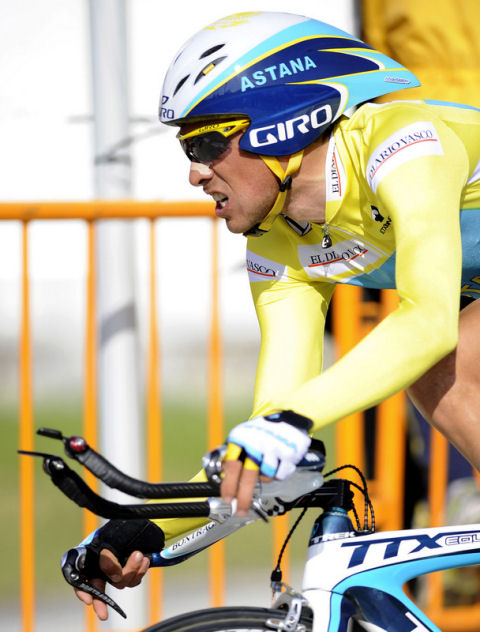
Contador was the best of the favorites in the Vuelta al País Vasco, leading the race from beginning to end. He won the first stage after an attack in Deskarga that nobody could respond to, and the last one, the time trial, in which he pulverized the opposition.
Q: You made it look like an easy victory. Was it?
A: No, it was far from easy. Every day there were difficulties and my team had to work very hard from the beginning. For that reason I feel proud of the great team I’ve had, because it allowed me to keep the leader’s jersey that I earned the first day. Fortunately, I was also able to finish off the great work they did.
Q: Have you raced with more anger since the exclusion by the Tour?
A: I wouldn’t call it anger. But I can’t deny that I’m more motivated considering I won’t be able to compete in cycling's greatest annual event this July. I have to take advantage of other items on the calendar like this one.
Q: Winning in Basque Country is always prestigious. But this year, with the star roster it’s had, it’s even more prestigious.
A: Winning here has special value, it’s very important. Aside from the three grand tours, it’s one of the more prestigious races at the international level, one that all cyclists want to win. In addition, a victory with Evans on the podium is even more prestitious. He’s been on the podium at the Tour.
Q: It seems that you didn’t race in perfect condition because of a toothache.
A: It started to hurt Monday night after the victory in Lezgapi. And as days went by, the problem got worse. I went almost two nights there without shutting my eyes because I didn’t want to take antibiotics for the inflammation I have now. This morning I was in a very bad way.
Q: With victories you’re making the Tour organization doubt the decision to ban your team.
A: The more my name is associated with victories, the more they’ll notice my absence in the Tour.
Q: And now, what’s your program?
A: First a little rest. Then I’ll speak with the team, but I imagine that we’ll do a training camp in the Pyrenees or Alps to lay a foundation for the Dauphiné, where I still don’t know if I’ll go to dispute the victory or not. Later, the Olympic Games and the Vuelta a España.
(photo: RAFA RIVAS/AFP/Getty Images)
61 kilos of dynamite
Diario Vasco - April 11, 2008
Kepa Zelaia, Astana’s physician, formerly of Discovery Channel team, is one of the people who best knows the physical machine of Alberto Contador, “a privileged constitution,” according to him.
“I got to know him in 2003, five years ago. I was surprised by the effort test performed by Dr. Alberto Garai. The result was spectacular, far above the norm for a young man of only 21.”
How was Contador different? “What stood out is the extremely resistant quality of his fine muscular cells. He eliminated lactates very rapidly. And he recuperated extremely fast.” These are qualities that the leader of the Vuelta al País Vasco has enhanced by training.
 Dr. Zalaia ranks him “at the level of the greatest climbers of all time, like Lucho Herrera or Marco Pantani. He weighs 61 kilos and he has a resting pulse rate of between 38 and 41 beats minute.” Of course, seeing him climbing the slopes with such a high pedal cadence, another of his characteristics, one can unequivocally state that it’s 61 kilos of dynamite.
Kepa Zelaia understands that Alberto Contador “has plenty of margin left to improve in the coming two years, especially in the time trial. He’s 25 and has not yet reached physical maturity. He eats moderately. I would even say that he eats little.”
“Self-control”
The Astana physician also emphasizes another aptitude which stands out in the effort tests. “Self-control. The cavernoma did not diminish him physically. On the contrary, I would say that it strengthened his character, level-headedness, and maturity.”
His grandmother died last Tuesday
He demonstrated those qualities recently, since his grandmother Maria passed away last Tuesday. She lived in Badajoz, Barcarrota, and had been hospitalized for several days. On Monday Alberto dedicated his victory in the Legazpi stage to her.
In the past few weeks, speculation has been that Contador was diversifying his preparation and his training plans after learning that his team, Astana, had not been invited to the Tour de France. Zelaia denies this alleged change.
“Normally, he had to be well-prepared for Paris-Nice. ASO didn’t invite the team to this race, so he then aimed to be in the best possible form for the Vuelta al País Vasco, occurring one month later in the pro cycling calendar. We limited ourselves to delay his fine-tuning. From this point of view, the preparation has been the same as last year’s. In any case, Alberto's not at 100% yet. He’s still capable of improving on the bike.”
The Vuelta al País Vasco ends the first part of Contador’s season. Zelaia realises that “a race like this one demands an important effort every day.”
"In addition, in his racing style he plays offense: he attacks a lot, and this uses more energy, so much so that Alberto could pay the price next Saturday in Orio. For example, during last year’s Tour de France he attacked in five out of the six mountain stages, and paid for his efforts in the Aubisque. We’ll see how he feels after the Vuelta al País Vasco, and decide about the follow-up. There’s the option of a training camp in the Pyrenees or the Alps, as previously planned. But for the moment we must wait. There could well be a change of schedule. We’ll see.”
A reminder: Contador will not be at the departure of the Flèche Wallonne and Liège-Bastogne-Liège, two classics lead by the ASO, the same entity that organizes the Tour, where Astana has not been invited either. The only possibility offered would be to take part in the Dutch Amstel Gold Race, but this race is not included in Contador’s schedule.
Alberto’s next objective will will be focused on the Critérium du Dauphiné Libéré.
(Translation by Christine Kahane)
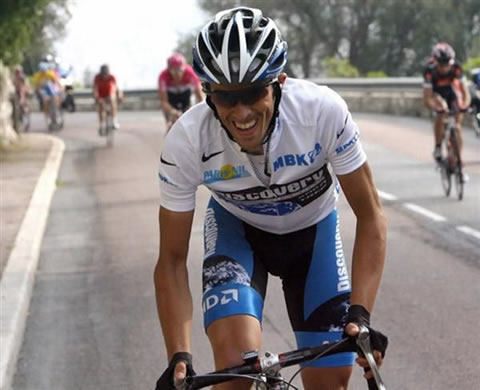 (photos: top right, Lucho Herrera in 1987; bottom, Graham Watson - the paceline)
“At 25, I’ve lived much”
Alberto Contador finds lessons in the hammer blows dealt by the cycling world, and still burns white-hot, enjoying every minute.
Diario Vasco, April 6, 2008
“I have a bad memory for the climbs, but I know more or less what I’ll find in the Vuelta al País Vasco. Last year the route was harder. It’s one of those races where you can’t just go for a walk.” Alberto Contador studies the parcours, takes note of the kilometers, the climbs, all the facts and figures.
Although not envisioning every detail of the next week, he knows the land perfectly. In fact, when he begins to reel off the stages, he first says emphatically, “ The Vuelta begins with a classic stage, the one at Legazpi, with Deskarga, Aztiria. I know that territory. I often spent time there when I was with Iberdrola.”
There were times during his amateur days in Gipuzkoa when he came from Madrid by bus, or lived in Oiangu and trained in that area. “Then there’s the finish at Viana, the Orio stage, the time trial. The Vuelta al País Vasco is one of those races with no rest day.”
He finished Castilla y León with a win and has set himself to prevail whenever he rides. The winner of the Tour de France 2007, who will not defend his title in 2008, has had to rearrange all his initial plans.
“In the Vuelta a Murcia I realized that I was still green. Because of that I trained a lot before Castilla y León. It went well. I had 15 days to recover and work on condition. I’m in very competitive form. I’m not at the top, but I’m good.”
Being a naturally slender cyclist, he’s lost nearly 2 kilos since the Vuelta a Murcia, something that he’ll notice on the highways of Euskadi where he’ll sign in having 17 days of competition under his belt, nearly ideal for a cyclist who usually reaches form quickly.
“I’ll begin with the idea of disputing a race that I’ve done several times, where I’ve had chances to win, where I’ve come close, but where you have to be 100%. To win? It won’t be easy, both because of the difficultly and the great participation.”
There’s another important factor for Alberto Contador: the allergies that affect him in April. “Last year they bothered me in the stage that Beltrán won. It was miserable, I could hardly breathe. In the last stage I also had problems. Those things can work against you, depending on how the race goes.”
None of his past appearances at the race have gone unnoticed: “In 2005 I came in third in the general and I won the time trial. In 2006 I finished fifth, after the debacle that reordered the general in the final time trial in Zalla. Last year things were not as good for me.”
In the Zalla finish in 2006, with everything in his favor, José Angel Gómez Marchante gambled against all odds, and Contador went down the tube.
When it comes to naming favorites, Contador thinks you have to examine the roster.
“Everybody talks about Cadel Evans, the entire CSC team, Popovych. I know that I’m said to be the main favorite, but there are more. Many riders will arrive in form and although nobody’s mentioning them, they’ll be up front.”
His plans after the Vuelta al País Vasco, whether he wins or not, are quite clear. “I want to go forward, and have spoken with the team about it. The plans will be similar to those I would do if I were thinking about the Tour. I’ll rest and train in the Alps and the Pyrenees, soon after I’ll do the Dauphiné Libéré and later we’ll re-evaluate what to do during July. I don’t want to think about it much, at least not at the moment.”
He confessed, “The Vuelta al País Vasco usually leaves you pretty beaten up, so to take it easy for a while is not bad, either.”
He won’t ride, but will go on living as if he were going to ride.
He says with emotion, “I’m doing well, I’m in good spirits. I love the bicycle, and racing competitively. I see how it is in cycling these days and it’s painful. I miss having the power to ride the Tour. Instead of thinking about it, I’ll mentally reboot, although it costs me. It’s not easy.”
He’s 25 years old and it seems that he’s been racing all his life, like a veteran. He has lived much, perhaps too much. “Yes, it’s true. At 25 years old, I’ve been through many things that many people won’t ever experience in their careers. What things? Not riding the Tour, for example, but there are other important ones. You rethink everything and you try to find the positive things. Not riding the Tour is not the crappiest thing that’s ever happened to me.”
Alberto Contador continues growing at all levels. He has become hardened, and not only physically. Mentally, the ups and downs that he has suffered are forging him into iron. “It’s clear that you become stronger. It allows you to see everything from another point of view, to value certain things very much. I’ve won the Tour and my life is not easy.”
He rebels when you tell him he’s a born cyclist, that’s why it’s easy for him. “It might seem that you win because you have the talent to do it, but winning is the fruit of constant labor. I’m a strong believer in training, in work. I train a lot, watching the series, controlling the effort I make."
"Since I was small I’ve been quite strict. When I raced in cadets they called me Pantani, because of the facility I had in the climbs. I heard that people said, ‘Pantani is going to burn himself up,’ but I never did.”
March 16, 2008
Contador: "I want to ride the Tour, but not at all costs"
Dutch journalist Sander de Vaan interviewed Alberto for the Dutch paper NRC Handelsblad on March 6, during the Vuelta a Murcia. Portions of the interview subsequently appeared in the German paper Die Welt and in other publications.
The full interview appeared in esciclismo.com .
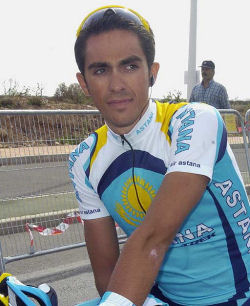 Alberto Contador weighs in officially at 62.5 kg. But if people could measure their indignation in grams, the winner of the last Tour de France would weigh perhaps twice as much.
And so the cyclist from Pinto continues to be dumbfounded by the decision of the Tour de France organizers (ASO) to exclude Astana from the next Tour.
“I wasn’t expecting it at all. It’s a leap backward for cycling."
"We deserve to be in the Tour. We’re a clean team and one of the most competitive in the world, but the chances are almost nil. Therefore we don’t have any other remedy left but to set new goals, like the Vuelta a España and the world championships,” Contador said.
The subject is even more regrettable because the Madrileño thought long and hard about joining Astana after the sponsor of his previous team, Discovery Channel, left cycling. It’s a fact that the Kazakh-sponsored team was ejected from the 2007 Tour as a result of several doping scandals, the most notorious being that of Alexander Vinokourov.
But then, everything changed.
“I mulled it over for two months. But when director Johan Bruyneel explained that he wanted to build a new team around me with many of the Discovery Channel people—masseurs, mechanics, technical directors, and all the riders who helped me win the Tour—I made the decision.
"Obviously, I also thought about the problems of last year, but the only thing left was the name. Everything else was new,” assured Alberto.
We spoke in the town of San Pedro del Pinatar in Murcia, a place that at first had not appeared on his calendar. As a result of the ASO ban, Astana can’t participate in races like Paris-Nice. The Vuelta a Murcia seemed to Alberto Contador like a good alternative, another chance to log kilometers and show the entire world that he’s not thinking about changing teams.
“I have principles,” says Alberto, who, in spite of all the problems, still looks like a kid. “I want to ride the Tour and to win it again, but not at all costs. For that reason, I’m not changing teams. I value too much what I have all around me. Also, since this team has nothing to do with the one last year, I also feel responsible for my teammates. If they don’t let us ride the Tour this year, we’re penalized, but what can we do?
 Strangely, Astana’s exclusion has not yet prompted a unified outcry from the other professional teams. But Alberto Contador understands.
“There are a great many people who acknowledge that this is incomprehensible, but the situation in cycling is so absurd now that they don’t want to get caught in the crossfire. I also think it gets on their nerves. They all express their support to me, but each one has a sponsor and often they can’t just say whatever they think.”
Besides Astana, T-Mobile also had serious problems last year. But the German team (now called High Road) apparently will now be able to participate in the Tour. In addition, the director of CSC, Bjarne Riis, who confessed in 2007 after years of lying that he won the 1996 Tour with EPO in his veins, hasn’t been banned by the ASO as of this time. For these reasons Astana might very well resort to the International Court of Arbitration (CAS) in Switzerland.
Nevertheless, Contador would rather not think about it. “I don’t know if they’re going to court or not. Those are matters for the team. I want to be focused on the races, to try to win and enjoy cycling. And I want to show the world that our team is the best one of all.”
Contador knows what it’s like to fight. In 2004, he had emergency surgery for a cerebral cavernoma. After release from recovery he returned to racing with a victory in a stage of the Tour Down Under. At the time, Alberto rode for Liberty Seguros, a team with close ties to Dr. Eufemiano Fuentes. As a result of the Operación Puerto scandal, Contador couldn’t take part in the 2006 Tour. And although his name was more or less cleared soon after, there have continued to be people who associate it with doping.
One of them was the German expert Werner Franke, who labelled Contador’s Tour triumph as “the greatest fraud in the history of sport.” Yet this is the same cyclist who has repeated time and time again that he was simply on the wrong team at the wrong time.
“It’s painful,” he says now. “The fact that in 2007 there was a young winner without a history of doping in the Tour, with a clean team, could have been a departure point for a new era in cycling.
But when you see that they don’t let the winner participate the next year, nothing makes sense anymore.”
“As soon as I arrived in Paris, stories about me started to circulate, among them Mr. Franke’s. It hurt, because I got there with hard work and a 100% clean record.
"In the end I gave a press conference, but it hasn’t done any good. It’s easy to make light of a public figure, but it can cause a lot of damage. Maybe, on the other hand, it’s a logical consequence of winning the Tour de France.”
In spite of it, have you truly been able to enjoy your victory?
“Yes. Right now those stories don’t affect me. I know that I haven’t done anything bad and that I don’t have anything to hide. I want to be optimistic.
"I’ve already been saying it for a long time, but I hope this all changes someday. However, I also know that nowadays in cycling it’s this type of thing that sells papers, not the sport. And as far as Operación Puerto is concerned, if the authorities need me for something, I’m completely at their disposal. I can’t do more than that.”
“In some ways, the Tour victory came before I expected it,” he says. “In 2007 I aspired to a stage win and maybe the maillot blanc, but I didn’t hope to win the Tour. I was still young, I lacked the experience and perhaps the confidence to win a three-week race. But because the Discovery team was so strong, I could keep up with the best riders.
"Also, I owe a great deal to Johan Bruyneel. He’s very smart, he knows how to read the stages and whether it’s best to attack or not. Thanks to my teammates I didn’t have to expend so much energy, which is the reason I got to the mountains in good physical condition.”
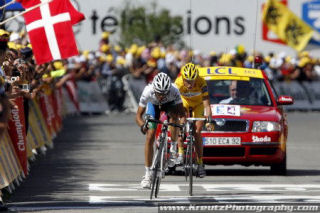 In the Pyrenees, rivalry between Alberto Contador and Michael Rasmussen sparked memorable duels that even intrigued viewers who were already jaded by doping in cycling, until the moment when the Dane was expelled from the Tour by his team, Rabobank.
“I still consider it a very unfortunate decision. If he didn’t abide by the rules, clearly he deserved a punishment, but not in the middle of the Tour, with the maillot jaune. I could stay with Rasmussen in most of the stages, but in the end he really was very strong.
"That’s exactly why I’m sorry they threw him out. If you let a rider start the Tour, you’ve got to let him go on to Paris, unless he has a positive test on the way. If Rasmussen had been 50th in the race, you can bet he wouldn’t have been thrown out,” said Contador.
Meanwhile, cycling sinks lower and lower, as much because of doping stories as because of the conflict between the organizers ASO and the International Cycling Union, the UCI.
“Sadly, we’re no more than puppets in this struggle for power,” complained Contador. “It’s infuriating. We’re all going through so much, yet it seems like it will never end. They don’t realize how much damage it’s causing to the sport.”
But wouldn’t now be a suitable time to step out of the role of puppets and present a common front? As the last Tour winner, couldn’t you play a key role in all this?
"I doubt it. It’s very difficult to get all the riders together, like shrapnel from a hand grenade. Each one has his own team and sponsor that pay his salary. In addition, in this type of thing, people talk and talk, and still nothing gets done. And it’s important to remember one thing: the organizers and leaders are the people in charge of this conflict. They must reach an agreement.
"I’m a cyclist. I feel truly happy on the bike, when I go out on the roads and can think about all the goals I still want to reach. One of them is another victory in the Tour, but time will tell when this will be possible.”
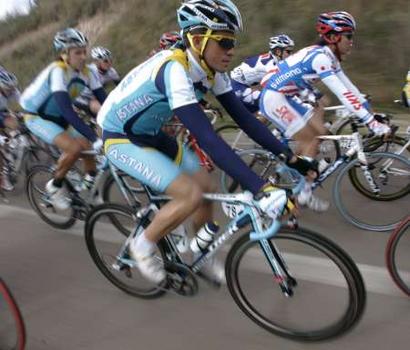
Read the interview in Spanish
Read the interview in French
photos: top, EFE; upper left, fotoreportersirotti; middle left, KreutzPhotography; bottom, Dani Cardona (Reuters)
February 25, 2008
CONTADOR AND THE CUSTOMERS
by Carlos Abellán, El País
Professional cyclist Carlos Abellán rode with Alberto Contador at Liberty. Unemployed as a result of Operación Puerto, he is now the creator of the webpage contadoraltour.com, which has obtained 17,000 signatures in four days.
The great response to the webpage has made me reflect on the following subject: Who is really the main character in cycling, who is really the main character in any sporting event?
If it’s clear that modern professional sport is closely bound to marketing, you have to ask yourself what marketing is. Wikipedia provides a clear and concise definition for us: “Marketing is the use of a set of tools directed toward the satisfaction of the customer.”
And who is the customer in sport? The fans, which is to say, the consumer power that justifies sponsors’ investment of significant sums in races, teams, and athletes.
And now I ask myself, “Is the central character in cycling really the spectator?” And I realize that, no, the different echelons of cycling are monopolizing the attention of the most important people with the absurd fight for power that they’ve been waging for a long time, and that the true protagonists, the spectators, are growing tired of feeling ignored.
This brings me to the story of the drastic decision of the Tour about not inviting Astana to the 2008 edition, the team in which the race’s current champion, Alberto Contador, rides. The Tour justifies its decision as being based on a standard of ethics – hardly a valid criterion if there’s a comparison to the treatment of the other team with a questionable past -, when in fact the reason Astana is in this position is because it [the Tour] wants to demonstrate to the UCI and to the team that it can impose its law because it has absolute power.
Nevertheless, neither the Tour nor the other echelons realize that it’s absurd to fight for power. Federations, like the organizers and teams, are essential pieces of the same puzzle.
Meanwhile, the fans, those customers who must be satisfied according to the definition of marketing, are getting tired. They’re getting tired because what they want to see is a sporting spectacle that this absurd power struggle prevents. The proof is in the heap of signatures requesting that this be rectified, indicating that cycling is a higher priority than political swagger, and asking for a return to common sense.
It will be too late when fans, tired of so much fighting, give up and devote their enthusiasm and time to something else. Then, when all the people who’ve signed (and all those who are yet to sign) stop following the races, cycling will be finished, because it no longer has a reason to be. Does it make sense to want to satisfy a customer who no longer exists?
The question is no longer whether Contador and his team ride the Tour. The serious matter is that cycling is crying for coherence, rules, and guarantees that do not exist. How can you convince a company to sponsor a professional team if it sees that a team with a budget of 15 million euros and one of the best organizations in the world cannot participate in the race that has the most repercussions in the media? How are you going to tempt the younger people into cycling academies if you destroy the careers of their idols?
Likewise, just as the one who prevailed as winner of the 2007 edition is not able to defend his title in 2008, it makes no sense, neither should it be tolerated, that the organizers declare publicly that a rider is not welcome to the race because they consider him suspicious—in spite of the rider having no disciplinary file open; or that teams are dismissing riders based on rumors and thus ending their participation in respective professional races, with no guarantees that they will be invited to certain races in other years.
In the text that I wrote for the webpage, contadoraltour.com, I mention the words of José Saramago that I heard on a CD by Ismael Serrano, because they fit perfectly with the initiative. Incidentally, before quoting them, the singer recalls other words that also go with the story: “Gandhi said: ‘An eye for an eye makes the whole world blind. And if we are blind, we are not able to see the suffering of others.’”
And that’s the problem in cycling, more than doping or the Pro Tour: they’re so blind in their absurd and rancorous fight that they don’t realize the suffering of the people on whom the whole story hinges, the fans.
February 22, 2008
Contador: “Leaving Astana is not part of my plans”
“Signing was a risky decision, but it was my mistake to make,” indicates the rider.
EFE - el País writes,
Alberto Contador, winner of the 2007 Tour de France, now riding for the Astana team, declared in an interview that his greatest desire for next summer would be “to be able to participate in, and to win, the Tour.”
“The best summer for me would be to take part in the Tour de France and if possible claim the title again, and, thinking about football’s European Cup, that the Spanish team could win it. Apart from that, if Raúl makes the team, that would be even better,” Contador said.
Lamentably, the Astana team has not been invited to the Tour by the organizers, and to change teams in order to participate is something practically impossible.
“To begin with, I have a contract, and even if I wanted to leave it would be practically impossible. But that doesn’t enter into my plans either, because I’m a person with priniciples.”
“I understand that the decision to sign with Astana was a bit risky, but it was my mistake to make,” explained the Madrileño.
“Right now there’s a team surrounding me and depending on me. And what I cannot do is desert all these people who are counting on me just because the Tour hasn’t invited us. I acknowledge that many, many fans want me to change teams, but I believe they’ll understand my position.”
Contador is, come what may, an optimist as he looks at his future. “I’m optimistic enough and since people are seeing that it’s an exemplary team, and it doesn’t show any resemblance to last year, opinions will change.
I’m not talking about this year, because I think that’s complicated, but about next year."
"It’s surprising and incomprehensible to me that they won’t invite us to the races with the team totally remodelled, but continue to doubt and prolong the situation.”
One thing the cyclist doesn’t lack is support from the fans. “I’m pleasantly surprised, because people are supporting me and exerting more pressure than I could have imagined.”
Also a web page has been created, contadoraltour.com, where fans can show their support for the Spanish Tour champion.
“Carlos Abellán (an ex-teammate from Liberty) called to ask if it would bother me if he did this web page, and I told him no, it wouldn't. That guy is a real jack-of-all-trades, and I told him he had my permission. It looks like participating in the Tour will be complicated, but if pressure can be made from all quarters, then so much the better.”
At the Laureus Awards, Contador was one of the nominees, but in the end the prize went to F1 driver Lewis Hamilton.
“It didn’t bother me that Lewis Hamilton won the Laureus. Of course, everybody likes to win prizes, but having one fewer didn’t annoy me. I went as a nominee and it was good to go, but I wasn’t disappointed.”
Photograph by trekbikesusa
February 19, 2008
SPORT'S REVELATION OF THE YEAR WENT HOME WITHOUT THE PRIZE
Contador: “Not doing the Tour is a step backward”
The Laureus Awards relegate Contador to second place. The Tour also voted.
Joan Vehils, sport.es writes
How many votes did the veto of Astana cost Alberto Contador? Without a doubt, negative influences made it to Saint Petersburg and affected the outcome of the Laureus Awards, although the cyclist has nothing to do with the scandalous behavior of Astana in 2007.
The “Oscar” for the Most Promising, or Revelation, of the Year left him standing at the altar. The fact that the winner was Lewis Hamilton (rookie British F1 driver) instead of Contador is significant. The Madrilenian rider possibly gave the explanation himself without knowing it: “Cycling is at the present time a sport without rules,” where “incomprehensible decisions without clear explanations” are commonplace.
The personal history of Contador before winning the Tour is heart-wrenching. When was he savoring the honey of triumph, when he was feeling at his best, a decision by the organizers eliminated his chance to defend the maillot jaune that he conquered last year with Discovery Channel.
“If instead of Astana we took any other name in the book, we’d be in the Tour,” he explained with bitterness, assuring that his new team, “doesn’t have anything to do with the one last year.
"We have invested approximately one million euros in antidoping measures and we, independent of UCI and WADA controls, have conducted twelve additional internal controls ouselves. This is everything we can possibly do. For that reason, if next year they don’t let us participate either, I’d be in favor of saying, ‘Let’s chuck it, and vamonos.’ It would be something incomprehesible.”
Contador is skeptical about the possibility of resorting to TAS, the Court of Arbitration for Sport: “I only see a one percent chance and I don’t want to awaken false hopes.”
His feelings now are “more rage than powerlessness,” because he thinks he deserved to be in the most important race in the world “in a year in which I see more strength and solidity than when I won. For me this is a step backward.”
His first reaction when he found out he couldn’t be at the exit line of the Tour was “to send them a DVD of the last edition, saying, “Watch this. This is Contador, this is the one that animated the race, the one that made the Tour more entertaining.”
He recognizes that although he has received the support of many cyclists, “this is a crazy sport where the unity we desire does not exist. If it existed, I wouldn’t be giving this press conference or discussing this subject.”
COVERAGE OF TEAM ASTANA BAN BY ASO
February 16, 2008
Spanish government supports Contador
February 15, 2008
Contador sticks to plan
February 14, 2008
Contador rages in Mallorca
Bruyneel disappointed: "incomprehensible"
Paris-Nice invitations indicative of ASO plans
Astana in disbelief over ASO decision
Prudhomme: "No more mistakes allowed"
Teams react to Astana ban
PRESS RELEASE FROM TEAM ASTANA
February 13, 2008
With surprise, disbelief, incomprehension, but dignity as well, Astana Cycling Team has been informed of the non selection of the team for the races of ASO, including Tour de France 2008.
“Since breaking with the ProTour, Tour de France is free to issue its own invitations. After the non selection for the Tour of Italy, we knew that there would be a chance that ASO as well could consider not to invite us”, says Team Manager Johan Bruyneel. “The Giro argument, that we do not come to the race with our best riders, is no longer valid. With Tour number one and three of last year, Alberto Contador and Levi Leiphemer, and with two times runner up Andreas Klöden, we maybe have a too strong team now?”
“That the happenings of last year in Tour de France, prompted the Tour organizers to leave Astana out of the season's most important race, sounds understandable. However, Astana Cycling Team 2008 has nothing to do with the team of last year. We have done everything to change the dynamics of the team. New management, new riders, new philosophy. Only the name of the sponsor remained. The Kazakh authoroties gave me “carte blanche” to run the team. No pressure was put on us, there was no demand for big wins. We are spending 460,000 euros on internal anti-doping efforts for 2008. What more can we do? The fact that UCI accorded us a ProTour license proved that our new system functioned well. Maybe that is a part of the problem. Is Astana this year a victim of the war between UCI and ASO?”
“ASO asked us in December open communication. We communicated a lot but never got a reply. ASO has probably the right not to invite us”, continues the Team Manager. “They want to augment the credibility of their races after the happenings of last years. Unfortunately, Tour the France will lose now much of its credibility by not letting participate some of world’s best riders, who even were never were implied in doping scandals. The name of Alberto Contador was sometimes linked to the famous Puerto affair. A Spanish judge cleared him. Even afterwards, Alberto was always available for justice to give required information. He really has nothing to do with that sad affair.”
Sports Director Alain Gallopin: “We cannot force anything. It is probably impossible to appeal against their decision. We will prove in other races that we are left home unjustly. It is better to know early than late that we cannot participate. There are still other races on the cycling calendar. I am disappointed for Alberto. Now I need to make soon a new programme for the riders and staff and go forward.”
“What strange is”, says Johan Bruyneel. ASO does not invite us because of the past of a team that had the same name. Many other teams, with a similar suspicious past, that even did not change management or structure, can participate without problems. Where is the consistency? Is Tour the France not loosing all credibility now?”
Tour de France winner Alberto Contador is deeply disappointed. After the 4th stage in the Tour of Mallorca, a stage he dominated, he declared with tears in his eyes :“The last weeks I never thought that it would be possible not to do the Tour de France. It is my race, I dream of that race. Yesterday I even did special tests at the velodrome of Palma to improve my time trial capabilities. We are not invited. What can we do?
Tonight I will look at the calendar. We have to change everything. Don’t ask me for the moment which races I will or can do. Anyway, I thank our sponsor who stays behind us, but I’m afraid other sponsors can leave cycling because of what happened today. It is a sad day for cycling.”
CPA denounces organizers’ decisions as “debilitating to the teams”
February 12, 2008
The Spanish press has widely reported that the Association of Professional Cyclists has expressed its uneasiness about the future of numerous riders “after the recent decisions of the organizers concerning invitations of teams to races.”
According to an official statement, the CPA believes race organizers “despise talent” and “debilitate” teams.
The CPA regards as crucial the hammering out of objective and precise rules for selection of riders and teams. They state that raising doubts about selection of the best riders affects patrons who out of necessity must guarantee their investments, and could bring about “the retirement of important sponsors.”
“Cycling cannot escape modernization and must adapt to the current economic context in order to survive,” continues the communiqué.
In addition, the CPA affirms that in future the subjecting of riders and their teams to the “arbitrary decisions of some organizers” is not a healthy situation.
“In the absence of clear rules it will always be the cyclists who lose,” it emphasizes.
Read MORE at cyclingnews
Toni Colom: “Contador will be in front”
February 9, 2008
Antoni Oliva of Diaro de Mallorca reports that Toni Colom is sure about his teammate’s chances in Mallorca
With an overall victory—in the 2004 edition—and two stages wins, Toni Colom of Astana has demonstrated that he’s the Mallorcan cyclist best able to win throughout the seventeen years of the Challenge-Volta a Mallorca. A circumstance that puts a special value on the opinions of this amibitious 29-year-old from Bunyola. A professional who’s sounding a warning on Alberto Contador’s chances for victory in the Challenge or one of its stages.
Poised to start the race at 11:35 tomorrow, Sunday, in the Passeig Marítim de Palma, Toni Colom issues an advisory about the victory options of the winner of the last Tour de France. “Contador will be ahead in the Challenge,” he warns.
Colom defines the young Tour champion as a “phenomenon.”
“He’s a different rider from all the others. A cyclist with an innate capacity to ride fast, especially upwards,” assures Colom concerning his new teammate and the leader of Johan Bruyneel’s Astana team.
“Contador always does well. He has so much class that, as a rider, I need two months’ work to be at his level when he comes back from vacation. In training camp at Jávea in December, he proved it to us. That’s why it wouldn’t be strange if he won the Challenge. Last year he was far ahead in the stage to Sóller that I won,” Toni remembers with admiration.
On the other hand, Toni Colom is not expected to win the Challenge. “I need to pace myself,” and offers that until now he has centered his preparation on “hours in the saddle, a base.”
“I need quality work to consider myself ready. My immediate goal for this year is Paris-Nice and the Vuelta al País Vasco, not the Challenge,” he clarifies. “I know I’m a good rider and that I don’t have to prove anything to anybody. I’ve already won the Challenge and other races in Mallorca.”
Colom contemplates the Tour de France as his main challenge of the season, although he knows that the second time he participates in the Tour “will be more difficult than last year. I’m on Bruyneel’s preliminary list, but to get on the Tour team is difficult,” he emphasizes.
Astana’s Mallorcan rider has another iron in the fire: “If I don’t go to the Tour, I’ll get in top shape for the Vuelta, where I could even go as team leader. In that case, it would be important to play a good role in the general classification. I’m at a the right age to compete for the victory in a grand tour,” says Colom.
BULLETIN 20
December 31, 2007
Contador “I’m only thinking about recapturing the Tour victory”
Josu Garai of MARCA interviews the best cyclist of 2007
Alberto Contador, by virtue of his triumph in the Tour de France, and his victories in Valencia (a stage), Paris-Nice (two stages and the final GC), and Castilla y León (a stage and the final GC), has become the cyclist of the year. Considering his palmarés and the fact that he just turned 25 last December 6, the man from Madrid could well dominate the next decade.
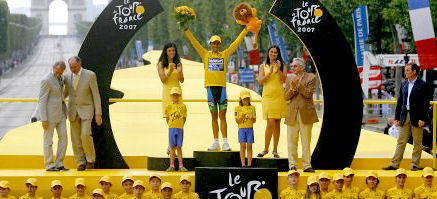 Winning the Tour has been a dream come true, no?
When I was a boy, my dream was to be a professional. Soon, as time went by, I started to dream about riding the Tour, and finally, about winning it. I’ve had the luck to achieve it at 24 years old, already I’ve started dreaming about going back to win it again.
You’re not considering other challenges?
So far, no. My goal is to try to recapture the title. If I didn’t think that way, it wouldn’t go well, would it? I know it’s hard, because it’s the most important race in the world and everybody wants to be brilliant, but I’ll be at the start line thinking about regaining the title. I have confidence in myself and my team, in which both Leipheimer and Klöden also have chances.
Let’s talk about that, about Leipheimer and Klöden. Won’t there be too many roosters in the hen house?
 People said that this year when Leipheimer and I signed with Discovery Channel, and everything has gone well. Levi sacrificed for me in Paris-Nice and in Castilla y León, he mortgaged his options to help me. And then in the Tour he stayed on the margin. I know there'll be no problem with him and I hope it happens the same way with Klöden. I trust that we’ll all respect one another.
That’s easy to say, but one of these days, at the moment of truth, it may not be so easy.
They have options, too, but I’m 25 years old, so it makes sense that I'll grow as a rider, and I already know what it is to win the Tour. I must be committed to them, and they must be committed to me. We must respect one another. In addition, to have two riders like them in the team gives you peace of mind because you know that if things don’t turn out well for me, they can try to settle it, too. But I don’t think about that: I like the pressure.
You have more confidence than ever in your chances.
That works like the chicken and the egg. When things go well, it gives you confidence, which makes things go better. The problem is that it also happens the other way around: when things don’t go well, everything falls apart. Still, right now I’m optimistic: I feel good, my confidence is strong, plus I have a team where I feel at home.
Have you already started training?
Yes, and from now on I’m going to follow a strict plan, like in 2007. I’ve been through too much commotion these days and now I’ve got to concentrate on the bike. I'm really motivated, and the truth is, I’m feeling pretty good.
In between commitments, are you having a good winter?
I’ve always been trying to look for holes in the schedule, to go out on the mountain bike or to do some walking. As I say, I’m really motivated on the road bike.
 How have you planned the season?
Like this year, with the first peak of form at Paris-Nice, but I’ll be facing it without pressure, not like this season, when I had to win. However, I like to go to the races in shape, competitive, not treat them like a walk in the park. Soon, after the Classics--Fleche Wallone and Liége-Bastogne-Liége--I’ll rest a little and shift my focus to the Tour.
Where will you make your season’s debut?
In Mallorca, I’ll ride there in a little while. Later Valencia, Paris-Nice, maybe Castilla y León and Circuit de la Sarthe and the Classics.
Is it too soon to start the season in Mallorca for a rider who likes to get to the Tour in great shape?
I like to race. Everybody says that I need to take time to rest, but I think the secret is in pacing the work well, because sometimes things go better with the team, in the transitional stages, than training at home.
 What’s your reason for giving up riding the Vuelta al País Vasco this year?
It’s just that it’s a very demanding race and I know that if I go I’ll end up jumping into the fight. Plus, it’s a time when allergies bother me quite a bit.
Except for that, the program will be very similar to 2007.
Yes, why change what's worked so well? The key is in pacing myself, and in recovery. Soon, before the Tour, I’ll do the Dauphiné, but only after proper preparation.
And what comes after the Tour?
The priority is the Tour, above everything else, but 2008 is an Olympics year and I really want to do the Olympic Games. More than the road race—which looks good for me because it has a 12 km ascent that's climbed seven times—I’m thinking about the time trial, which climbs the same ascent twice. The race suits me pretty well, but it’s essential to finish the Tour, because if not…
And the Vuelta a España?
This year it’s going to be problematic, although I don’t discount it. I really want to race at home, plus the route this year is a very good fit for my characteristics. Everybody knows that an athlete’s plans can change due to circumstances: crashes, sickness, injuries…
Right now, is there something that you worry about? Are you afraid of anything?
No, nothing. I want to recapture the Tour title, that’s everything to me. But if I don’t, I won’t consider it a failure or that I’ve been cheated. I’m beginning with the end in mind, a win, but if I don’t get it, I won’t be depressed about myself.
You’ve won your first Tour at 24. Have you thought about how many you can win?
No, I haven’t stopped to think about that. People say I can win five and even approach Armstrong’s seven, but I say you have to go one step at a time. I don’t make accounts like that, that would just be showing off.
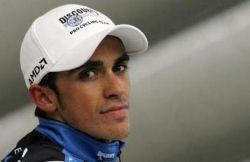 photos: top, KreutzPhotography; right, KreutzPhotography; middle right, Paris-Nice, AFP;
left, Vuelta al País Vasco, EFE
photos: top, KreutzPhotography; right, KreutzPhotography; middle right, Paris-Nice, AFP;
left, Vuelta al País Vasco, EFE
Translation: Bruno Lopez Vizcon
BULLETIN 19
December 23, 2007
El Mundo Deportivo reports
Alberto Contador has been cycling’s great revelation of 2007. He started by winning Paris-Nice, which was within the realm of possibility for a rider in his class. Nevertheless, he also won the Tour and, at 24, that was something not even he had expected.
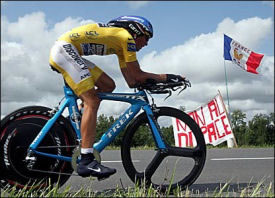 “I went to London ready to fight for the young riders’ white jersey and suddenly, in the Pyrenees, I was competing for the yellow, to win the Tour. I never hoped to win it, it was something I didn’t expect, surprising and with a wonderful result,” the cyclist from Madrid told MD in a tone that was both shy and determined.
After that he spoke to us about what came next and, mainly, about his hopes for a career that is already splendid.
You’re a draftee in a new team, Astana, so how was your first meeting last week at the training camp in Jávea?
Very good, so much that I was surprised and happy when I left. I think we’ll have a well-balanced team of a very high level. Better even that the one last year in Discovery. I saw all the riders excited about becoming a group of friends with the same goals. Everything was very easy from the first moment with the two initial groups, those of us that came from Discovery and those that were already in Astana. But right away, logically, communication problems with the Russians blew us into little pieces like a hand grenade.
In this first encounter, there was no Andreas Klöden, the latest signing with the team and someone who’ll be, in addition to your teammate, your rival at the Tour.
 I don’t know what the conditions were in his signing with Johan Bruyneel, our manager. But I totally trust him and he trusts me. I know Johan from last year and there’s a thing about him that I really like: he looks you right in the eye and tells the truth, and gets directly to the point.
Surely the situation with Klöden has been like that, so that he knows he’ll have to work for me just as much as I work for him if he’s the one in a strong position. On the other hand, I really like the pressure that he provides to my status in the team by his presence. I think that it’s really a mutually beneficial relationship.
What does it mean for you to continue with Bruyneel next year?
For me, it’s very important because I think he’s an intelligent director who knows what it is to command a team where the Tour de France means more than anything else. He has won it eight times, more than anyone else. I agree he’s always had a powerful team at his command and a leader with charisma who could guarantee results.
So far my relationship with him is superb. He knows me like the back of his hand because he’s been following me since I became a professional, and his support makes things happen.
What did you think when you heard Bruyneel would retire?
Man, I knew that was bad news for me because it meant the end of the really good times we had shared, including the Tour de France victory. But I scouted around, studying the market. I was determined to go on with my career the best way possible. Later Astana called him to take the position with the new team, and Bruyneel came looking for me. Immediately I understood that he was interested.
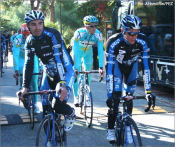 With Christmas almost here, where are you in your preparation for next season?
This year I’ll do less weight training so that from training camp at Jávea onward, I’m already on the bike. I trained with my teammates and now I’ll do the same, but at home. The pity is that I don’t have much time at the moment. I’ll follow this routine until the last week of January when the whole team goes off to the USA. Klöden, Leipheimer, and Horner will be there, too, and others that were not at Jávea.
Obviously, the prime objective of the 2008 season will be the Tour de France, but before that you’ll do Paris-Nice, which you won last year. Will you resist the temptation to go there to win?
Anyone who knows me knows that I’m not satisfied simply going to the races. Paris-Nice I really like, because it’s suited for a racer with my qualities, but I assume that those are very early days to be in peak form, although I’m conscious that with the number one on my back I’ll have a tacit obligation.
At the Vuelta presentation ceremony last December 5, I got the impression that you really like it. Will you do anythng special to be in shape to compete?
Next year, the problem is the Olympic Games in Beijing. As I understand it, the route is hard and would be wonderful for me. The Olympic Games are tests of the highest level and prestige that only come along every four years, and I want to take this opportunity to have a completely good experience. My idea is to do the Tour and later travel to Beijing.
Are the routes in the Olympic Games the type of one-day race that goes well for you?
In the time trial, you climb the Great Wall seven times. You go up and down all along it and the goal is located at the end of the last slope. In the road race the circuit is longer, but very similar. If I have to give up racing the Vuelta a España next year, I will. I’ll be 25 years old and I can afford the luxury of coming back in other years.
Bruyneel thinks of you as the man of the future, but thinks you’ve got to improve against the clock.
That’s the way it is. This year, I’ll do specific training to improve my position on the bicycle. It’s fundamental for my racing, although next year the Tour has only 80 kilometers of time trial compared to 120 kilometers this year. I think the next Tour will be good for the man who’s strong, who’s best prepared. It doesn’t benefit just one type of rider. I like it, although I’d like it better if there was a mountain time trial, but certainly, you can’t have everything.
Who will fight against you for the Tour triumph?
Klöden, Evans, Menchov, Valverde, Sastre, Andy Schleck, and some unexpected people that can climb.There’ll be underdogs, too. Who knows how fitness is going to be at that point in the season.
Will being in Bruyneel’s team make you a product of “the Armstrong school?”
I’ll be a product of “the Contador school,” although Lance and Johan knew what had to be done to win the Tour. But I’ll be thinking about this. Now I just want to disconnect the phone and enjoy Christmas.
photos: top, bbc.co.uk; middle right, ES Marca; middle left, Alistair Hamilton
BULLETIN 18
December 20, 2007
Contador plays St. Nick to kids at South Madrid hospital
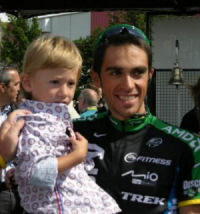 ATB News reports that Alberto Contador, winner of the last Tour de France, distributed toys yesterday to children at the University Hospital of Getafe, on behalf of a goodwill campaign organized annually at Christmastime by the city’s Popular Party.
Contador toured the hospital wards giving out gifts to the children. He was accompanied by the spokesman of the local PP, Carlos Gonzáles Pereira.
The Tour champion told Europa Press that children who spend Christmas in the hospital, “ don’t get along too well. I, fortunately or unfortunately, have had to spend a long time in the hospital, too,” the athlete remembered, referring to a cerebral hemorrhage that he suffered a few years ago. The illness nearly forced him to quit cycling.
Contador was delighted to take toys to the children “because they get excited about it, and it’s a such a small thing to do to give joy and hope to children who are patients here. It’s a very important thing, to make them feel a little better, since they’re away from home,” he added.
The Getafe PP’s goodwill campaign has a similar goal every year: to bring gifts donated by local companies and individuals to all those people who for different reasons don’t get a Christmas present. Last year the people who distributed gifts to the children at the Hospital were players for Getafe CF football team.
photo: Contador with young fan, July 10, 2007
BULLETIN 17
December 18, 2007
Catching up with Jávea
Starved for news from Astana's training camp at Jávea? Here are a few bites, which will have to be enough for now. If it leaves you greedy for more, remember your Dickens: Enough is as good as a feast.
Bruyneel: I'm sticking with cycling thanks to Contador
Johan Bruyneel, directeur sportif of Astana, has indicated that he wouldn’t have continued in cycling if Alberto Contador, reigning Tour de France champion, hadn’t come to the Kazakh team.
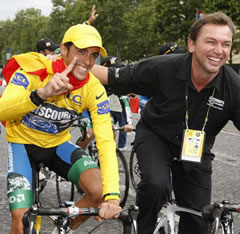 The directeur sportif declared, “I had decided to to retire, since there was nothing else in the sport to aspire to. Now the challenge is to put this team into action. Without Alberto Contador, I wouldn’t have continued. He’s a good foundation to build on, he’s young and one of the best. His signing was what convinced me to keep going.”
The Belgian boss, with eight Tours in his palmarès as a directeur sportif (seven with Armstrong and one with Contador), voiced his total support for the Spanish cyclist, the cornerstone of Astana, although he didn’t forget that expectations will have to be satisfied during the upcoming season. “Alberto is one of the best, but there are other riders with potential. He’ll have to demonstrate again that he can win the Tour and he relies on all of us to have confidence in him to do it. He has everything in his favor. He’s newly arrived and now has what he needs to fight for everything. He reminds me in many ways of Armstrong, and I know he’ll be the leading figure of the future.”
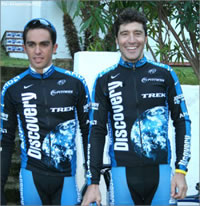 More reading!
Chechu Rubiera tells Contador of his experiences with Armstrong
Read Life with Armstrong. See CHECHURUBIERA.INFO.
Alistair Hamilton of PezCycling News visited Astana's training camp at Jávea on the weekend:
The man at the helm, Johan Bruyneel has the job of welding these two distinctly different elements into one super team and with Tour winner Alberto Contador leading the charge it should be another successful season for the man that was behind the Lance Machine.
Enjoy PEZ on the Scene: Astana's First Camp! (with photos)
See PEZ CYCLING NEWS
Photos: Reuters, Alistair Hamilton for PezCycling News
BULLETIN 16
December 6, 2007
Happy Birthday, Alberto!
Alberto Contador is 25 years old today.
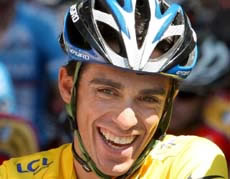 He's one of the youngest Tour winners in history, and the youngest Spanish winner ever. Next year he'll still be eligible for the Best Young Rider prize.
Alberto was born in Madrid on December 6, 1982, the third of Francisco Contador and Francisca Velasco's four children.
He grew up in Pinto near Madrid with his two brothers, Francisco and Raúl, and his sister, Alicia. He's a first generation Madrileño. Alberto's parents moved to Pinto in the 1970’s, leaving behind a large extended family in Barcarrota, Extremadura. Alberto loves his family, and often travels to Barcarrota to see his grandparents, aunts, uncles, and cousins.
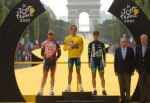 What birthday present do you give someone who has a new house, a new car, a new team, and the 2007 Tour de France title? For the Contador family, shopping must have been difficult this year!
Everybody knows that, gift or no gift, a birthday song makes any guy feel special on his day. The traditional Happy Birthday to You is always a good choice. Try it in the key of F, then join Alberto in a SONG that must be even more meaningful (it's in A-flat).
December 6 is also the feast day of St. Nicholas, the patron saint of children. A rich legend surrounds the 4th century Bishop of Myra. During his lifetime he is said to have given gifts to the poor anonymously, and to have saved sailors from shipwreck by appearing as an apparition and helping them pry their ship loose from the rocks.
Stories tell of him reviving three boys who had been chopped up and pickled by an evil butcher. Saving these helpless children, and his reputation as a free giver of gifts, is the basis for his modern image as Santa Claus.
St. Nicholas is the patron saint of Alicante in Spain, where Alberto will join new team Astana for training camp December 10-18. Nicholas is also very important in Brittany, the coastal region that harbors the first five host cities of the 2008 Tour de France.
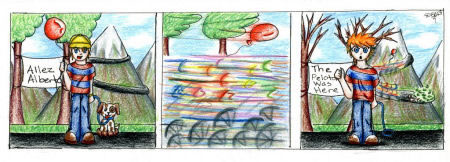
Another icon is turning 25 this year. It, too, is something many cycling fans can't live without
The emoticon was invented in 1982 by American Scott Fahlman. Fahlman, a computer scientist, proposed using the symbol :-) to point out humor for readers who weren’t sure.
The idea was perfect for computer-age communication. It was quick and funny, and it freed people from a struggle for verbal expression that had been going on since the Stone Age.
Harvey Ball’s 1963 graphic creation, the Smiley, is the quintessential emoticon. Mr. Smiley has fathered many colorful and animated children.
Smiley is now revered as the patron saint of emoticons. To believe otherwise would be emoticonoclastic. ;-)
¡Feliz cumpleaños, Alberto! May 25 be as full of good things as 24 for Contador, and even more.
Photo: Tour 2007 (RAI), artwork presented with permission of the artist, Beka, and cyclingfans.com. Thanks, Pete!
BULLETIN 15
November 28, 2007
Contador wins the Velo d’Or
Alberto Contador has won the prestigious Velo d'Or, or Golden Bicycle. The prize, given annually by Velo magazine, goes to the year's best cyclist.
Contador was chosen by an international jury of 18 journalists. Only one other Spanish rider has ever been granted the honor. Five-time Tour de France champion Miguel Indurain claimed it in 1992 and 1993.
BULLETIN 14
November 28, 2007
For Contador, the good life is training
He stood under the Arc de Triomphe—a cyclist’s gateway to celebrations—four months ago. But Alberto Contador still has to hustle to keep up with his social calendar.
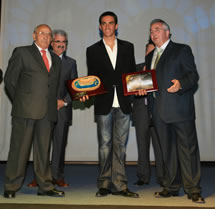 Last Friday found him in Chiclana in Cadiz, a place that’s crazy about sports, especially cycling. Alberto visited Chiclana to attend the annual Sports Gala of the Vipren Foundation. The event is the creation of ex-cyclist Federico Bahamontes, the “Eagle of Toledo.”
Bahamontes, 79, can easily identify with Contador. A climbing specialist, he became Spain’s first Tour winner in 1959, going on to claim six KOMs. Contador, the fifth Spaniard to wear yellow, is following the Eagle’s career flight path. He may soar even higher.
Contador was the chief honoree among more than 40 athletes from different disciplines. One of many notables was former Olympic cyclist José Manuel Moreno (gold medal, Barcelona, 1992). The two men together in the same room brought to mind a question. Will Contador seek to follow Moreno’s example in Beijing?
For now, one thing is clear: He’s had enough champagne and caviar. “I’ve got to cut out the galas because it’s time to concentrate, and I’ve already begun to get ready for next season.”
Alberto commented about this and other matters to MARCA
BULLETIN 13
October 31, 2007
Tour de France 2008 parcours suits Contador
The winner of the Tour de France 2007 says he’s happy with the route planned for next year. Alberto Contador attended the presentation of Tour 2008 in Paris on October 25, and has analyzed the parcours. He says he’d prefer it if there were “a prologue and a time trial for the climbers, but this way it will be a more difficult challenge, and more interesting to tackle."
Contador sized up the 2008 edition in general terms. “I like it and I expect it will give me possibilites to look for the victory, and to offer it to the fans again.”
Looking ahead to the mountains, Alberto likes what he sees. “There are four summit finishes, including the mythical peak of the Tourmalet in the middle of one stage. Also, the queen stage ends on Alpe d’Huez, after the Galibier and Croix de Fer. It will be a very beautiful stage to try to win.”
Regarding the rooftop of the race, the Bonette-Restefond, he commented that it’s “something different, and it could take a toll on some riders because of the lack of oxygen at those heights. With 2,800 meters, there could be some surprises, but for me, I don’t think it’s bad, because this year I felt well on the Galibier, where I attacked.”
Contador also approves of the upcoming time trials. “They’re good, I just would’ve liked a mountain time trial to give me the opportunity to take time instead of losing it to some specialist.”
Tour de France 2008 official presentation video: see YOUTUBE
BULLETIN 12
October 27, 2007
Contador: “With this route, I can think about the victory”
The winner of the 2007 Tour assures that the 2008 edition will be a new challenge in his life and hopes to demonstrate that he’s at the highest level.
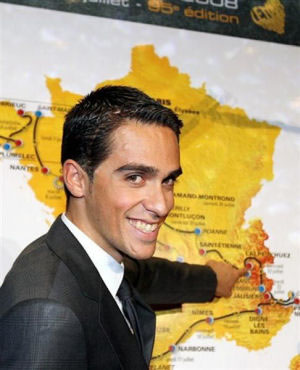 “I would have liked it better if there had been a mountain time trial and a prologue on the first day. That would have been perfect for me, but it is what it is. So it will be a more important challenge for me to be able to demonstrate that I’m at the highest level in any route,” said Contador, speaking at the October 25 ceremony unveiling the route for the 2008 Tour de France.
Contador played down the influence that wearing the number one at the start would have on his performance. “I rather like the pressure, it’s something that goes along with winning, and I just have to accept it,” he said. “It’s impossible to say that I’m going to win, because that’s something very difficult to do, but I’m going with the hope that I’ll be able to revalidate the title,” affirmed the cyclist from Pinto, who indicated that if he had designed the route, it would have taken another shape. “I hope to adapt to this route and to fight for the victory.”
Contador pointed out that the stage which ends on the Alpe d’Huez, Stage 17, is the “star” of this year’s edition, and has paid attention to it with the goal in mind of taking a victory there, just as he marked Plateau de Beille for a win in 2007.
As far as the new measures taken to fight against doping, like the biological passport, Contador said that “in the short term it will be difficult to eliminate all the suspicions,” but was optimistic that it can “clean up this sport if it’s applied with the necessary physical and economic means.”
The colors of Kazakhstan
Contador will meet the challenge of capturing his second consecutive Tour title in the colors of a new team, Astana, to whom he committed a few days ago.
"After evaluating for several months the different offers, I didn’t know which one to choose. The image of last year’s Astana has been dimmed by scandals. I’ve had doubts, I’ve spoken with my family and I’ve seen that it was the best option,” he said.
“The technical organization will change totally. It has a competitive team guaranteed to be, on the 5th of July, in condition to fight,” he assured.
Contador said that the arrival at Astana of his Discovery team director, Johan Bruyneel, was a key element in his decision to go to the Kazakhstani organization, although it also had much to do with the fact that they've selected a thoroughly competitive body of riders.
“We’re going to apply anti-doping systems similar to those of CSC. I believe it’s a very important step in changing the image of the team, and seeing all this, I believe that I’ve made the best decision,” he commented.
from La Vanguardia, October 25, 2007
Photo: Contador targets Alpe d'Huez (AFP)
BULLETIN 11
October 24, 2007
Benjamin Noval: “It’s a joy to follow Contador”
La Nueva España reports today that Benjamin Noval will go with the Tour de France winner to Astana for two years.
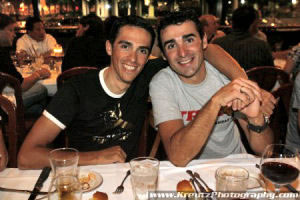 Alberto Contador, winner of the last Tour de France, announced yesterday that he has accepted Astana’s offer and will go to the Kazakhstani team for the next two seasons. The Madrileño officially recognizes that he’s willing to take a bet on this team because his sports director with Discovery Channel, Johan Bruyneel, also chose Astana. Contador is taking along Asturian rider Benjamin Noval, who will continue to be his lieutenant in the next Tour. Noval explains, “A long time ago I had an agreement with Bruyneel’s group to go together to the same team and to follow Contador, who always showed that he wanted to take me wherever he went.”
Noval, 28, proved his worth last June in the Dauphiné Libéré when he demonstrated to Contador his skill in sheltering the leader against the wind and risks of crashes in the flat stages, so that Contador could be fresher in the mountain stages. Contador, a skilled climber, appreciated Noval’s willingness to work hard at a job that was not glamorous. He strongly requested the Asturian’s presence to give him the same help in the Tour. In spite of a serious crash that sent him through the back window of a car, with serious consequences, Noval continued to labor for Contador. In addition, Noval established a great friendship with the champion in France last July when the two were roommates.
Contador, after gaining the Tour, put Noval’s mind at ease by assuring him that he would take him along to his next team. He has been good to his word. In fact, the Asturian had signed a contract with Bruyneel to go en masse with Contador, Leipheimer, and Paulinho, which has now become reality in Astana. Contador explains that he goes to Astana because “it’s a totally new project with people I have confidence in. The idea is to be in the next Tour de France, looking to revalidate my title.”
Whereas Noval says, “It’s a great joy to follow Contador, and to be able to assist him to the maximum degree with my efforts.”
Photos of Contador and Noval at the Tour of Missouri by Liz Kreutz
BULLETIN 10
ALBERTO CONTADOR SIGNS FOR TWO SEASONS WITH ASTANA
October 23, 2007
 Alberto Contador has signed a contract to ride with the new incarnation of the team Astana. Contador will lead the team in the Tour de France. Having won the maillot jaune in the last edition of the La Grande Boucle, his main objective for 2008 will be to repeat the victory.
Contador has reached an agreement with Johan Bruyneel, the new general manager of the organization, to head the completely remodeled team. There will be many changes in personnel, both riders and technical staff, beginning with new sports directors, Frenchman Alain Gallopin and Russian former rider Viatcheslav Ekimov.
 After many rumors, it is only now that Contador has signed an agreement that he values, especially because it will allow him to focus all his efforts on the Tour de France. “My main objective in 2008 will be to ride the Tour de France and try to confirm the yellow jersey in the Champs Elysees,” he declared. “After considering the different offers that I’ve had, I’ve opted for Astana because it’s a completely new project, with absolute sports guarantees, and that will put all the resources for a great Tour team at my disposal.”
Johan Bruyneel is also quite satisfied with this agreement. “The new Astana project is magnificent, and I’m very happy to be able to have Alberto Contador lead this team, because he is the rider of the future. With him, along with the other riders that have formed the basis of my previous team, we hope to be able to present a great Astana at the start of the next Tour de France.”
Contador is no stranger to Astana kit. After the demise of the Liberty Seguros team in 2006, he rode in Astana colors until being sidelined by an injury in August 2006 at the Vuelta a Burgos. The injury prevented him from taking part in the Vuelta a España. He remained out of competition until signing with Discovery in January of 2007.
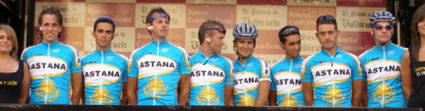
Photos: left and bottom, Vuelta a Burgos 2006 (guanjo)
BULLETIN 9
HIGH AND LOW IN VALL d'UIXO
October 21, 2007
Discovery Channel’s Alberto Contador finished on top yesterday in the 2nd Criterium International "Festes de Familia Sagrada i Sanctissim Christ" in Vall d’Uixo.
The criterium in the Valencian region of Castellon was a part of the city's traditional annual festival. In what must have been a grueling affair, Contador’s endurance was tested by his opponents. His hosts also made demands.
The criterium, a race in two acts, consisted of a points contest and another by elimination. Oscar Sevilla of Relax GAM got the better of David Bernabeu (Fuerteventura) and Contador, in a spirited performance in the first round.
The real drama happened in round two, the elimination test, when Contador decided to perform for the audience. Sevilla could no longer keep his breath under him, and faltered in the final laps. When the man from Relax dropped out with five riders to go, Contador, free of his rival, upped the tempo, treating the vast assembly to some of his trademark spectacle. He tucked in and let fly, his bike singing across the line. A bravura finish to a scintillating aria, it was enough to earn him the overall title.
 The 2007 Tour king's many social duties began on Friday, the day before the heat of competition. Criterium hosts, in the frenzy of a festival that lasts for days and days, proved they knew how to cool things off and take it down a notch. Before climbing either a hill or the podium, the young champion was asked to descend.
Local dignitaries had a surprise in store, below ground. Their treat was a guided tour of Les Coves de Sant Josep, a cavern near Vall d'Uixo. Contador and others were entertained with a boat ride on the Rio Subterraneo de San Jose, the largest navigable underground river in Europe.
A large number of VIPs in little boats went along to explain the wonders of the cave. Contador was reportedly captivated by the experience. When he emerged, he declared, “This is really lovely.”
After spelunking, the Madrileno enjoyed a meal of empedrao with his hosts. Empedrao is similar to paella, the pride of the Valencian region, birthplace of Spain's culinary icon. It's traditional fare during the feast of the Holy Family and Holy Christ.
Contador let the public know his feelings about Vall d'Uixo at a Q&A session with fans. When asked how he liked the city, he said, "I've been very pleasantly suprised. I had never been to Vall d'Uixo before, but in the few hours I've been here, I've been delighted."
Photo credits: top right, AP; bottom left, riosubterraneo.com
RIO SUBETERRANEO DE LAS GRUTAS DE SAN JOSE
BULLETIN 8
CRITERIUM IN VALENCIANA 2
October 20, 2007
Criterium International de Vall d'Uixo
(Criterium International Ciclisme "Festes Patronals Sagrada Familia i Santissim Christ).
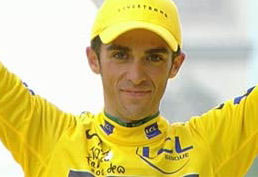 Alberto Contador heads back to the Valencian Country today for the 2nd Criterium International de Vall d'Uixó. The event is slated for 10:00 AM.
He'll top the list of of 37 participating cyclists. Some other big names will be present: Stefano Garzelli, Oscar Sevilla, and Angel Vicioso are a few of the celebrites expected. The rest of the roster will consist of other elite, professional, and sub-23 riders.
Hosts Union Ciclista Vall d'Uixó have marked off an urban circuit for the race. A huge crowd will be there, eager for entertainment and a look a the 2007 Tour de France winner.
The criterium comes on the penultimate day of the city's traditional festival of the Holy Family and Holy Christ. The festes is designed to be both a meaningful celebration for citizens and provide a spectacle for tourists. Programs take place throughout September and October, encompassing religious ceremonies, bullfights, disco parties, fireworks, and the piece de resistance, cycling. The festival will culminate in a mountain bike cicloturista on Sunday.
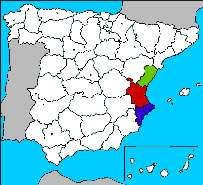 Vall d'Uixó is in the province of Castellón, on the Mediterranean coast of Spain. The region (green section on map) lies just to the north of Valencia.
Contador was recently in Valencia for their eighteenth annual Criterium Internacional. Valencia's extravaganza will be a hard act to follow, but the city of Vall d'Uixó may rise to the mark.
Photo credit: AP, Map credit: Spainprop
BULLETIN 7
CRITERIUM IN VALENCIANA
October 12, 2007
XVIII Critérium Internacionál de la Comunidad Valenciana, October 6-7, 2007
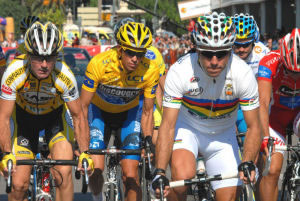 Alberto Contador nabbed the overall win last Sunday in the XVIII Critérium Internacionál de la Comunidad de Valenciana. The ingeniously-conceived series of events took place over the weekend in Spain's east coast city.
The Critérium Internacionál was much more than an exhibition race. Race organizer Podium Eventos Deportivos laid a three-day fiesta before the public. Many cycling events were united under the banner of health and handicapped awareness. It also offered plenty of family fun time. Spread along Valencia's tree-lined avenue, the Paseo de la Alameda, around 75,000 people enjoyed a sports fair, themed play areas for children, and games like bowling and darts.
Contador was the main attraction, but he was not the only illustrious cyclist present, or the only Tour winner. Homages were paid to retiring pro Ángel Edo, who is leaving the peloton after a 16-year career, and World Cycling Masters Champion Miquel Alandete, as well as World Paracyling Champion Maurice Eckhard.
The festivities began on Saturday with the II Marcha Cicloturista de la Ciudad de Valencia. This mass ride was open to all "cicloturistas," or in other words, anyone who loves to get out and ride a bicycle. In the second edition of the event--a race and pleasure ride wrapped into one--3,000 riders traced the Mediterranean coast in the splendid autumn sun.
The crowning glory of the peloton was unique: never before had two new Tour de France winners ridden side by side in such an event. Contador was joined for the Marcha by Óscar Pereiro, newly-acclaimed winner of the 2006 Tour.
Those who chose to ride competitively could measure their skills against the crème de la crème of pro cycling. In the final straight, it was Miquel Alandete who tested Pereiro. Alandete (b.1969), a Valencian, is a professor and an aficionado of English philology, but he's also got great legs. The champion of the UCI's division for senior amateur riders gave Pereiro a scare in the final moments. The Galician champ fended him off and took the sprint, wise enough to "beware of an old man in a hurry."
After the finish, Pereiro didn't stop racing. He left immediately, due back in Vigo where a city-wide bash awaited on Sunday, a tribute to their native son and 2006 Tour de France hero.
Although he wasn't the winner, Contador sounded pleased to be a part of the communal experience, remarking, "We're all cicloturistas." He finished the day by presenting the eight winners of the Marcha with their jerseys.
Sunday's rapid fire of events was carried out with "British punctuality," as they said in Valencia. The route for the criterium had been created along the avenue of the Alameda, a circuit of a few hundred meters bookended with tight 180-degree turns. A tiny stage for a big show, it allowed thousands to see the action. No contestant was ever out of sight--unusual for a bike race.
The criterium happended in two parts: a points race, and a contest where the winner was determined by elimination. In the first stage, riders made 15 laps of the circuit, with sprints every three laps. Alberto Contador was pursued by 24 rivals, but he dug in and put on a good show for the fans. He bested Edo, Alandete, and the others to take stage one.
The elimination race saw the same 25-man group erode little by little. The guys who didn't make the cut exited the course giving "high fives" to every fan within reach behind the barriers. Whittled down to two, Contador and Ángel Edo made a gutsy play for the finish line. The veteran got there first, ending his career with fireworks and a victory over the Tour de France king. Contador got the overall title, and everybody was happy.
One other event on the docket was Alberto Contador vs. a very strange opponent: a powered hang glider. Another was a surprising and, in fact, inspiring contest among ten handicapped cyclists, under the leadership of Maurice Eckhard, current World Paracycling Champion. The paracycling race was preceded by a manifesto demanding greater public awareness of the needs of the disabled, read by Contador.
True, his batteries never seem to run down, but Alberto looked a bit spent as he perched smiling on the back of the convertible during his final honorary lap, towel in hand. His fellow glitterati, Alandete, Eckhard, and Edo, accompanied him on motos, clinging to the backs of their chauffeurs.
Contador has been given a multitude of gifts and prizes since winning the Tour, for example, a canary named Paris. On the podium after the criterium, he struck a wheelie pose with his newest gadget, a motorized bike. Could it be his secret weapon next July?
Photo: from left, Angel Edo, Alberto Contador, Miquel Alandete. Courtesy of Miquel Alandete
PHOTO GALLERY
BULLETIN 6
CONTADOR, THE DON QUIXOTE OF CYCLING
October 3, 2007
A feature by Adolfo Cortes V., Kansas City Hispanic News
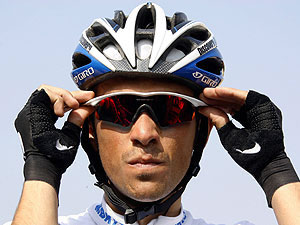 He does not ride on Rosinante's back, but on Jaca de Acero, a mare made of steel. Nor does he live in a village of La Mancha, but travels the world competing as a professional cyclist. His figure, though, is similar to the ingenious Hidalgo's, for he weighs 62 kilos and is 1.76 meters tall. He is not attended upon by a squire like Sancho Panza, but he does have a loyal friend in his fellow countryman Benjamin Noval, his roommate during the last Tour de France and faithful teammate.
Nevertheless, the human history of Alberto Contador, the current king of the Tour de France, is as fascinating as that of Don Quixote de La Mancha. Alberto did not have to fight against windmills, but against a cerebral hematoma that struck him on May 12, 2004, while he was competing in the opening stage of the Vuelta a Asturias. He not only ended up in a hospital bed but was plunged into a coma, hovering between life and death.
Cut off from cycling for eight months, he never abandoned his dreams, and, to the utter amazement of doctors, magically recovered and started to train on the bike again. Nobody at the time thought he had the slightest chance of doing something noteworthy on the bike, except Discovery Channel, who offered him a contract, after Liberty Seguros.
"There are circumstances in life when you learn a lot, and above all to value and appreciate your environment in a different way. The support of my manager, Manolo Saiz, and the help of Lance Armstrong's book were a key motivation in my comeback to cycling and my victory in the Tour de France two years later. It's a dream come true. My life has changed drastically. And the celebration in Spain has not ended yet," says the barely 24-year-old cyclist who has been the main attraction in the Tour of Missouri's first edition, where he granted an exclusive interview to Hispanic News.
Friendly with fans and cordial with the media, Contador admits that the pressure in Spain after his Tour de France victory is intense and so are expectations. Alberto is the youngest Tour de France winner since German Jan Ullrich's victory in 1997. "Can you imagine? They expect me to win the Tour eight times!" explains the rider from Madrid.
How is it possible to face such a high level of pressure? "The main thing is that, on one hand, I manage to cope with it, but on the other hand, the pressure I put on myself is the most intense because I know that I'm my own rival. My first priority for the 2008 season is to be on a team whose principal objective is the Tour de France, because it's motivating to try for a second victory. It seems complicated for me to work for a Spanish team because they already have their planning scheduled for the next season, and I want a team composed of riders who believe in me. My wish is to keep Johan Bruyneel as sports director, but we'll see what happens," adds Contador.
To all those who see in him the new master of the Tour de France, Alberto says, "It's hard to predict because every season is different. I want to face one thing at a time, and my mind is now focused on 2008. What I want is to work the best I can, have a strategic training program like I had this season, and in the end we'll see how many Tours I can win."
The Tour of Missouri had a very special meaning because it was the farewell of Discovery Channel, the world's dominant team, with eight Tour de France victories in the last nine seasons. The fans' enthusiasm displayed along every stage simply outstripped all the organizers' expectations.
"Of course, the disappearance of Discovery is a shame, but hopefully a sponsor will come along and keep a nucleus of excellent riders like Levi Leipheimer or George Hincapie, who are natural potential candidates for a Tour de France victory," says Contador.
A subject that always causes controversy is doping. The last Tour de France was no exception, with Rabobank's expulsion of Michael Rasmussen, who had lied about his whereabouts, probably to avoid anti-doping tests. This occurrence opened the door to victory for Contador, whose name had appeared in the police investigation carried out in Spain known as "Operacion Puerto."
"I'm clean," stresses Contador. During the Operacion Puerto case I was in the wrong team (Liberty Seguros) at the wrong time. By definition my name was linked to this case, but later on the UCI corrected the error. I have nothing to do with it," emphasizes Contador.
In conclusion, Contador admits that he knows little about Mexican cycling, his main reference being Julio Alberto Perez, who was King of the Mountains in the Giro. "I never met Raul Alcala, but know he was one of the best Tour cyclists."
To read this article in Spanish, see KANSAS CITY HISPANIC NEWS
Photo credit: elmundo.es; Liz Kreutz
Translation by Christine Kahane
BULLETIN 5
SHEPHERD OF THE HILLS
August 24, 2007
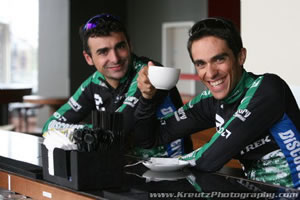 La Nueva España reports today that Benjamín Noval, Discovery Channel, will not ride the Vuelta a España as planned.
Johan Bruyneel, directeur sportif of Discovery Channel team, has decided to change Noval's schedule at the last minute so that the cyclist from Mieres in Asturias can continue his job of shepherding Tour de France winner, Alberto Contador.
The Spanish duo will travel with the team to the USA next month to ride the Tour of Missouri, which will take place September 11 - 16.
Noval's performance in the Dauphine Libere in June impressed Contador, who then asked for his help at the Tour. His hard work, sacrifice, and loyalty in France in July won him a place as Contador's right-hand man.
There are indications that when Contador decides his future after the disbanding of Discovery Channel team, he will take El Toro de Mieres with him as super-domestique, for protection on the flats, in the wind, and in moderate mountain stages.
Noval had hoped for a shining performance in the Vuelta. But now he's going happily to Missouri, looking for a triumph for his companion.
Read more about Benjamín Noval at Chechu's Amigos
Photo credit: Liz Kreutz
BULLETIN 4
STATEMENT BY ALBERTO CONTADOR
August 11, 2007
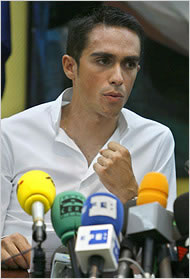 Dear friends, fans who have encouraged me on the roads or in front of the TV screen, media, sponsors, organizers of cycling events, and officials:
The events that occurred following my victory in the last Tour have made me reflect. All this is new for me. While I was concentrating on the race and the role I had to play within my team, I was not aware of anything else. I did not realize the real impact on the winner of this race, although I had seen it on TV.
It’s only after finishing the race that I started to realize it: police protection, a big crowd always around me, my phone ringing non-stop, a lot of people asking for autographs, and the press, a lot of press people…for better and for worse.
Three years ago when I was on the point of making a debut in the Tour, a painful experience forced me to quit because of an illness which almost took my life or could have ended my professional career.
But frustrating as it was, my illness was less painful than the doping scandal that enveloped me through the team I belonged to at the time, and which resulted in my exclusion from the 2006 Tour. It was a powerless, sad, and disappointing situation which changed my perspective on my sport, the sport to which I am devoting the best years of my life, the sport which, as I wrote in my letter of last year, I always practiced in a clean way, with courage, tenacity, hard work, sacrifice, and a great deal of hope.
Now, with my status as 2007 Tour winner, the most important race in the world, the race every rider dreams to win, the race won with effort and integrity, I request from you the same effort in order to carry on believing in cycling and in me.
And because I won this race in a clean way and enjoyed knowing, as you told me, that you had a good time in front of the TV, I assure you that you will continue enjoying cycling with me, because my objective, on top of winning races, is to make cycling an attractive sport admired by all.
For this reason, it’s impossible for me to understand the attacks made against me, questioning my integrity as a sportsman, from people who don’t know me but feel they can make such judgments, evaluating on TV my abilities, giving a diagnosis of my physical state and my moral tendencies. Some of them even pretend to be MD's.
The doctors I know, who treated me when I was ill and thanks to whom I am here now, would not speak in public, or in these words, about one of their patients, and even less about any other doctor’s patient.
I HAVE NEVER BEEN DOPED AND HAVE NEVER TAKEN PART IN A DOPING ACT, and those who know me know what I think about it. My commitment against doping is total and I will always be willing to cooperate. For this reason, I have always submitted myself to the cycling controls; season after season and year after year I have sent to the UCI the locating questionnaires in order to be tested by the sports authorities at any moment they wished. I went through both surprise and scheduled tests, in my house as well as during races, during the season and off-season, tests of blood and urine, which logically as you may suppose are countless and much more numerous than the tests gone through by the remainder of the race participants.
I count on the total support of the UCI, the Superior Council of Sport, the Spanish Cycling Federation, and the Secretary of State for Sports, Jaime Lissavetzky. The venue where this act is held guarantees my statement.
And even more, I am at the disposal of all the the authorities competent in doping (UCI, WADA, Olympic Committee, Federation) for any test they find appropriate to perform on me, including my DNA.
I don’t know if there is still something for me to do in order to be considered the rightful winner of the race. But if after this appearance, during which I express my complete cooperation, the defamatory reports and attacks against me—which harm my family, my cycling team, sponsors, and teammates—still persist, I will take all legal measures at my disposal in any democracy to defend myself.
And if the enormous harm done to me could be economically compensated, part of it would go to the fight against doping.
This is the contribution that Alberto Contador Velasco, winner of the 2007 Tour, makes for the credibility and revival of the new cycling, which without the help of media, officials, laws, and fans would not be possible.
Thanks to all.
Madrid, August 10, 2007
Video link to speech excerpt, MARCA
Photo credit: Pasco Campos/European Pressephoto Agency
Translation by Christine Kahane
BULLETIN 3
DOUBLE DUTCH FOR CONTADOR
August 8, 2007
UCI boss Pat McQuaid fired the start gun that set Alberto Contador on a course to his second win in a row in the Netherlands on Tuesday.
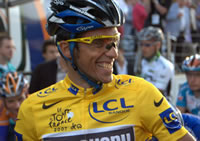 The Surhuisterveen Profronde, raced annually since 1949, treated fans to a close look at the 2007 Tour de France winner and other cycling heroes.
Contador was signed to ride the 80 km criterium immediately after his victory in Paris. With little experience riding in the Netherlands, he said it was a complete honor to be chosen to participate at Surhuisterveen.
Race organizers looked forward to Contador’s visit as an “absolute high point.” Committee president Joop Heida noted that no former Tour winner of Spanish descent had ever raced the criterium. “We are terribly proud that the effort to contract him has succeeded.”
Another coup for Surhuisterveen was booking Giro d’Italia winner Danilo DiLuca. Organizer Adries Nieuwenhuis commented "that we also have the winner of the Giro as a starter, in addition to Contador, is of course unique.”
DiLuca was sought as a last minute substitute for Michael Boogerd, who raced his final Tour in July. The veteran Dutch favorite is very busy on the criterium circuit, saying goodbye to an adoring nation before his 2007 retirement.
Contador becomes the third Tour de France winner to take part in the Surhuisterveen Profronde, after Laurent Fignon and Marco Pantani. Past winners include Robbie McEwen, Ivan Basso, and Erik Dekker.
Results: 1. Alberto Contador, 2. Danilo DiLuca, 3. Peter Weening
Photo credit : Paul Raats
BULLETIN 2
CHAMP CONTADOR FIRST AT ROOSENDAAL
August 7, 2007
 Alberto Contador got the royal treatment on Monday at the 28th Draai van de Kaai. Discovery Channel’s 2007 Tour de France winner led the entourage across the finish line in the twilight exhibition race.
Super Draai van de Kaai takes place annually on the second Monday after the Tour.
It’s the only Dutch post-Tour criterium that requires the cycling-mad fans to pay admission. Getting soaked for €12 didn’t put the damps on the feest this year, nor did the weather, which was not super dry.
The evening’s plan went like clockwork. 60 km and 22 laps around the center of Roosendaal took Contador to the winner’s podium. There he graciously received the accolades due a winner of the Tour, pulling a new maillot jaune over the top of the one he was wearing.
Michael Boogerd, in 2nd place, was also celebrated. Soon-to-retire Boogerd is currently enjoying status as a Dutch national hero. He netted a prize of € 7,500, just ahead of 3rd placed Steven de Jongh, with €5,500. Marianne Vos, the winner of the women’s division, was only granted €1,000!
Fees and prizes totalling around €62,500 made it a good day’s work for Contador. Alberto went home with new gold on his shoulders, and a little more in his pocket. Not bad!
Crowds out in support at Draai van de Kaai, despite the rain
BULLETIN 1
CONTADOR A GENTLEMAN, DEKKER GAFFES
July 31, 2007
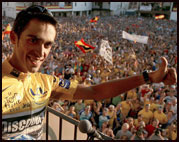 A foxlike Thomas Dekker nipped Alberto Contador in a sprint on Tuesday, July 31, to win the Stiphout Criterium. This post-Tour appearance for Contador would typically be regarded as an exhibition for the maillot jaune, who, by gentlemen’s agreement, would be first to cross the line.
Dekker had other ideas, and flying in the face of etiquette, snatched the win. Dekker’s boo-boo was probably no worse than wiping your hands on Mom’s Tuscan lace tablecloth. But Contador, fresh from his victory on the Champs Élysées, had to be satisfied with second.
Contador had the chance to compare the fervor of the Dutch fans with those in his hometown of Pinto. The crowd in the Brabante on Tuesday might have been full of adoration, but it couldn’t have equalled the all-out bash in Spain that welcomed the hero the day before.
26 July 2007
On the list, off the list - Alberto Contador and Operación Puerto
Andrew Hood, VeloNews European correspondent writes, In the chaotic hours before the start of the 2006 Tour de France, officials from the UCI and the Tour de France were frantically scouring a cryptic 36-page facsimile sent by Spain's Guardia Civil that summarized evidence of one of Europe's largest and most elaborate blood doping rings.
Officials received the fax on Thursday -- just 36 hours before some 189 riders would start the opening prologue in Strausbourg -- and were under the gun to match a series of veiled, soon-to-be-famous codenames to the Tour peloton.
The summary document - written in Spanish - included the most explosive and damning evidence confiscated in police raids in May 2006 that later became known as Operación Puerto.
The next morning, while riders were going on their final pre-Tour training rides, officials quietly approached various squads. Based on review of the summary documents, nine riders from four teams were linked to the alleged doping ring orchestrated by controversial Spanish doctor Eufemiano Fuentes.
Later that afternoon, the list of the "Puerto Nine" was released to the media.
The biggest bombshells were pre-race favorites Jan Ullrich and Ivan Basso. Also banished were Francisco Mancebo, fourth overall in the 2005 Tour, and Oscar Sevilla, the Spanish climber on Ullrich's T-Mobile team.
The entire Astana team featuring pre-race favorite Alexandre Vinokourov was removed because five of its nine starters were on the list, leaving the team of Manolo Saíz short of the required six starters.
Almost overlooked on the list was Alberto Contador, the man who is now poised to win the 94th Tour de France.
Contador cleared
As the Tour attempts to regroup Thursday following the controversial ejection of race leader Michael Rasmussen, new questions are being raised about Contador and his presence on the Puerto list last year.
Many are wondering how he appeared on the Puerto list and why he is racing in the very event that he was ejected from one year ago.
The short answer is that it appears in a rush to cull information from the hastily assembled evidence, Contador was identified based on references to his name that appeared in the first review of police documents.
A more thorough review when officials had more time, however, revealed no damning evidence that Contador was implicated in the doping scandal.
A Spanish judge and the UCI both cleared Contador. Even the elusive Fuentes, speaking last year on Spanish radio, said he never worked with Contador.
"I was on the wrong team at the wrong time. My name was on this infamous list, but one week later, the UCI had more time to examine the documents and I was taken off. My relation with Puerto was annulled," Contador said. "I was cleared of any link with the scandal."
That didn't stop journalists from grilling Contador on Thursday after he slipped on the maillot jaune for the first time and asked him straight up if the world could believe him.
"I'm clean or I wouldn't be here right now," Contador said. "I have passed all my controls, both in and out of competition, without problem."
Contador also denied he works with controversial Italian doctor Michele Ferrari, the infamous preparatore who worked with former Discovery Channel captain Lance Armstrong.
"I've never seen Ferrari and I wouldn't recognize him if I saw him. I've never spoken a word to him," he said. "My doctors are the ones from the team. I don't work with anyone else."
Name in documents
Contador's appearance on the Puerto list could have killed his budding career.
Discovery Channel boss Johan Bruyneel said he checked out Contador's story before signing him to a contract, saying the Spaniard's situation was different than Ivan Basso's, who eventually confessed being part of the Puerto doping ring despite lying about it for nearly one year.
"I have no reservations about Alberto," Bruyneel said. "The UCI admitted they made a mistake by including Alberto in this case. It's a whole other story for Alberto."
VeloNews obtained a copy of the original 36-page document sent from the Guardia Civil to authorities in France last July.
After a thorough review of the document, VeloNews found only two mentions of Contador. Neither of those two references could be linked to illicit doping products or doping practices, officials later decided.
The first reference to Contador is mentioned on a list of then-Liberty Seguros teammates (spelling mistakes remain as is) that appear on a document later to identified as a list of training schedules for members of the team:
En el documento 3 se observan marcados de distinta forma los nombres de los corredores: Dariuz BARANOWSKY; Josefa BELOKI; Ginpaolo CARUSO; Alberto CONTADOR; Allan DAVIS; David ETXEBARRÍA; Igor GONZÁLEZ DE GALDEANO; Roberto HERAS; Jorg JAKSCHE; Isidro NOZAL; Sergio PAULINHO; Nuno RIBEIRO; Luis León SÁNCHEZ; Michele SCARPONI; Marcos SERRANO y Ángel VICIOSO.
The second reference includes initials of riders' name that appeared on another training document:
En el reverso del documento 31 se localizan unas anotaciones manuscritas con el título "INDIVIDUALIZACIÓN" en el que se identifican a distintos corredores del equipo LIBERTY-SEGUROS WÜRTH por sus iniciales: R. H. (Roberto HERAS), M. S. (Marcos SERRANO), J. B. (Joseba BELOKI), I. G. (Igor GONZÁLEZ), A. V. (Ángel VICIOSO), J. J. (Jorg JAKSCHE), A. D. (Alan DAVIS), L. (sin identificar), A. C. (Alberto CONTADOR) .
Contador's name was also heard in taped phone conversations of Fuentes, but authorities said his name appears only in reference to conversations about race results.
Even Tour officials seemed content that a rider on last year's Puerto list could win this year's scandal-ridden edition.
"He was part of the dossier at first, but after closer review, he was rightly removed," said ASO president Patrice Clerc before Thursday's start. "His name was mentioned in taped phone conversations, but the references were related to sporting results. In no instance could his name be linked as a client of Fuentes or Operación Puerto, so his name was excluded."
When asked if the world can trust him, Contador gave a friendly smile and said, "Yes, of course."
31 March 2007
Contador: "I have done my work"
CyclingNews.com writes, Alberto Contador sealed the overall classification at the Vuelta a Castilla y Leon on Friday after getting over the Santa Inés and Piqueras climbs without difficulties while Fransisco Ventoso won the fifth and final stage.
"Thanks to my teammates for controlling the race," Contador said after the final stage. The most pressure came for Contador and Discovery on the second climb of the day. "It was complicated to defend my leadership in this last stage because Koldo Gil and his teammates, mainly Juan José Cobo, attacked us. But I felt very well, and Leipheimer does not allow any complications."
The Spanish Discovery Channel leader is "very happy" and says he must now "decide on my presence in the Vuelta al País Vasco," explaining that he has held his form for a long time already this season and may need a break. "I fulfilled the goals I planned for this first part of this season. If I take part in the Vuelta al País Vasco, it will be different from other years (where Contador contended for the overall - finishing eigth in 2006), because, although I like the race very much, I have already done what I wanted."
27 March 2007
From grahamwatson.com, On that stage to Mende, we saw the emergence of Contador as a future champion, as well as the raw ambition of Discovery's riders who had missed the big move on stage two.
Stage five saw Popovych solo to a superb victory and put Rebellin under intense pressure - the Ukrainian was by himself for 40-kilometres at the tail end of a day-long escape with six or seven others.
And when Contador then attacked on the Col du Tanneron with one day to go, only to be caught with a few kilometres left, it looked as if Paris-Nice had reached its climax, but that Rebellin would remain race-leader to the end. Wrong…
Somehow, Discovery's stamina, endurance, and determination ran to a whole stage longer, allowing them to explode the final stage around Nice and send Contador on his merry way to victory. It was as good, if not better, than the glory days of Lance Armstrong's 2004 Tour de France, when the Americans danced over everybody else.
In Paris-Nice, what was so exciting was that this was a comparatively young team, with no Armstrong to lead or inspire them, and no stalwarts like Hincapie, Rubiera, Padrnos or Ekimov to guide them. Instead, we watched men like Paulinho, Vaitkus, White, Devolder and Danielson dance to the three-pronged tune played by Discovery's hard men - Leipheimer, Popovych and Contador.
Although the American team has as many more rugged choices to call on for the Tour, the seven men who helped Contador win the greatest race of his life deserve a huge amount of merit for what they achieved in France. So yes, I hope Milan-San Remo is a big one this year, and gives us a big, big winner. But it'll be hard to beat the excitement, power, and ambience of even one day of Paris-Nice.
27 March 2007
Contador is ProTour leader
AS.com reports, Alberto Contador (Discovery Channel) will be wearing the white jersey as leader of the UCI ProTour in Castilla y León.
“For me, it is a source of pride to wear this jersey for a while, although I suppose they'll take it from me soon after the Classics.”
24 March 2007
CyclingNews.com, Discovery's Paris-Nice conquistador
16 March 2007
Graham Watson writes, Alberto Contador was true to his word yesterday when winning the crucial and brutal finish-climb of stage four. But the little Spaniard must be regretting his error of missing the split that cost him over 20-seconds at the end of stage two to Limoges.
But for that oversight, Discovery Channel would now be leading Paris-Nice by a decent margin, and the black and blue ‘train’ would have a bright yellow jersey sitting proudly down its line-out.
Still, the six seconds that separates Contador from new race-leader, Davide Rebellin, is not insurmountable. And as we saw yesterday with former race-leader Franco Pellizotti, even the strongest riders can come unstuck.
To be honest, Rebellin will be much harder to shift, not least that he has even more years of experience in situations like this, as well as the fact that the three days remaining favor more this strong Italian than the sparrow-like climbing phenomenon that is Contador.
Aside from Contador’s great win yesterday, it was inspiring to see the Discovery Channel riders performing to their maximum in order to get themselves into a winning position.
For all but the first hour, the whole team was at or near the front of the peloton, making sure a three-man escape did not get too far ahead and beyond their reach.
Until the conclusion of yesterday’s stage there was any number of cyclists who could have taken the race-lead, so minimal have the time differences been since the start last Sunday ... (from thePaceline.com)
TOUR DE FRANCE 2006
Tour 2006 : A Personal Account
When his team was excluded from competition at last year’s Tour de France, Contador’s hopes were dashed. Here, he tells about the bewildering and painful episode.
”It was a difficult time. I remember that when they arrested Manolo Saiz, I couldn’t imagine the after-effects and consequences it would have. I didn’t think it was important because I never thought my name would be related with this doctor (Fuentes), a man I never even saw or spoke to in my whole life. I never thought it could have the least repercussions for me. The days prior to the departure of the Tour de France, a series of rumors and lists of riders started to appear, and on the eve of the prologue I was told that my name was on those lists.
“Although I denied it, I was told there was a possibility I could be prevented from taking part in the Tour de France. It seemed incredible. I had sacrificed a lot of things to arrive in the best condition, and I was told I was pushed aside because of something that was beyond my understanding. In the end I had no alternative but to return home.
“These were difficult moments, not only for me, but also for my family and the people who follow me. That weekend my parents had gone to Paris to see the prologue while, instead, I was returning home.
“I had some bad days, but it soon came out that my involvement with this doctor was nil. He admitted that he didn’t know me, and within ten days the Union Cycliste Internationale (UCI) stated that I could return to competition. But it was too late for the Tour, and the injustice had already been committed.
“This, like the accident, caused me to mature. All this is beyond one’s control, and the innocence of every rider is questionable. Nowadays it’s not necessary for a person’s anti-doping test results to be positive for him to be sent home. There are no fixed ethical criteria anymore. Everyone interprets them in his own way. Because of that I was forbidden to compete last year.
“Thank God the teams knew all about my situation. I got many offers, and could choose the one I thought was the most interesting.”
Tour 2006 : Cycling, the Black Sheep
Alberto evaluates the impact Operación Puerto has had on cycling.
“It has been doubtless very negative. Cycling has been ruined because of Operación Puerto. Four out of five cycling articles are about doping and Operación Puerto. It’s sad, but that’s the kind of stuff that sells papers. As a consequence, every newspaper that can get some news on that subject, does it. It’s terrible.
“In my opinion, cycling is a nice sport, a beautiful sport that motivates fervor. But it seems to be a black sheep, while other sports are untouchable.
“I totally agree to anti-doping controls, and to being controlled myself, although I would like all sports to be considered on the same level. It’s unbelievable that a rider’s whereabouts have to be known 24 hours a day and 365 days a year. We are treated like delinquents. It’s unthinkable.
“But after all, cycling is what I like to do. It’s my way of life. It’s my work, although there are still things I don’t understand.”
1 July 2006
Tour 2006 : Open Letter to Fans
Alberto Contador wrote the following letter to his fans to tell them how he felt after being excluded from the Tour de France.
Dear fans and cycling lovers,
Two years ago you supported me through a difficult experience, when I endangered my personal and professional life during the Vuelta a Asturias. More recently, during the past year, I shared with you the reality of my recovery and my successes during 2005. For all this, and because you supported me with your cheers or wrote my name on the road, and gave me the necessary strength to endure this latest terrible obstacle, I feel I have to share with all of you what has happened to me, and let you know the way I feel about it.
It’s only by chance that I came to love cycling, chose a life of sacrifice, effort, suffering, and decided to forego a normal youth in order to become someone I would be proud of, someone who would make me feel privileged: A PROFESSIONAL CYCLIST.
And because I know that there is nothing more satisfying than to reap the fruit of one’s efforts and work, I need to let you know that I now feel sad, disenchanted, powerless, and much more, to such an extent that no words can express my current state of mind.
I am a person who believes - and life has shown me - that experiences that appear damaging and unpleasant at first sight can have positive outcomes. I know that my future professional and personal life will be marked by the scar of these days, but I’ll try to remember only the good things, and carry on working and making efforts, with even more enthusiasm, if possible, to make you enjoy this beautiful sport, which I beg you to believe in, and to believe in me.
To you, youngsters who start in this sport, I ask you to share something with me: MAKE CYCLING A SPORT THAT EVERYBODY ADMIRES. And, because I believe in a clean sport, that is how I always PRACTICED IT, I know that in a few years we will get a worthwhile reward.
With kind regards,
Alberto
4 August 2006
Tour 2006 : Parents' Protest
Alberto Contador’s mother and father publicly voice their reaction to the injustice done to their son at the beginning of the Tour de France 2006 :
Public condemnation from Alberto Contador’s family
The powerlessness and distress that we, as parents of cyclist Alberto Contador, feel these days has led us to make a public condemnation of what has befallen our family since our son has been forbidden to participate in the Tour de France. We are supposed to live in a democracy where laws exist to protect the citizens....
According to the law, a person is presumed innocent until proven guilty. However, our son has been punished in being barred from taking part in the most important sports event, without the least consideration of destroying his efforts, sacrifices, work, and hopes to improve his results from the previous year. Where are his rights, our rights, in all this?
Some past family experiences, which are beside the point, made us realize that corruption exists at all levels of modern society, and that moral values are disregarded without due consideration or scruples. Nevertheless, we are convinced that honesty and peace of mind are most important in life, and consequently have tried to transmit these values to our children. As parents, we are proud to say that we have succeeded in our endeavor, and that our children have adopted these values. And this peace of mind, that we are so proud of in our family, is the only thing that supports us in such an unfair situation as the one we now have to deal with.
We have seen our name slandered, dishonored, humiliated, and as a consequence we now feel distressed, depressed, ashamed, and are facing sometimes ill-intentioned and sarcastic comments. And all this as a result of having taught our children to do good! Who will answer to all that? To the moral harm done to us, we could add the huge amount of patience that is required of us to clarify the situation, since to this day nobody has explained to us why our son has been forbidden to take part in the Tour.
Nowadays, when it’s so difficult to be a good parent, it’s distressing to see our son suffering irreparable harm when he always tried to do his best: a life of sacrifice, training in the rain or in the heat at 40°, having to go to sleep early because he must be well rested the following morning for a 200-kilometer training ride. And all this destroyed without the least consideration or scruples.
Nevertheless, our son carries on training in view of the Vuelta a España, with the feeling of not knowing why a name appears and another disappears from those wicked random lists in such a carefree and frivolous way.
2006
16 April 2005
CyclingNews.com, A new lease on life
Web design by Nicky Orr and Modem Operandi. Masthead photo credits: (1) bbc.co.uk (2) Liz Kreutz, kreutzphotography.com.